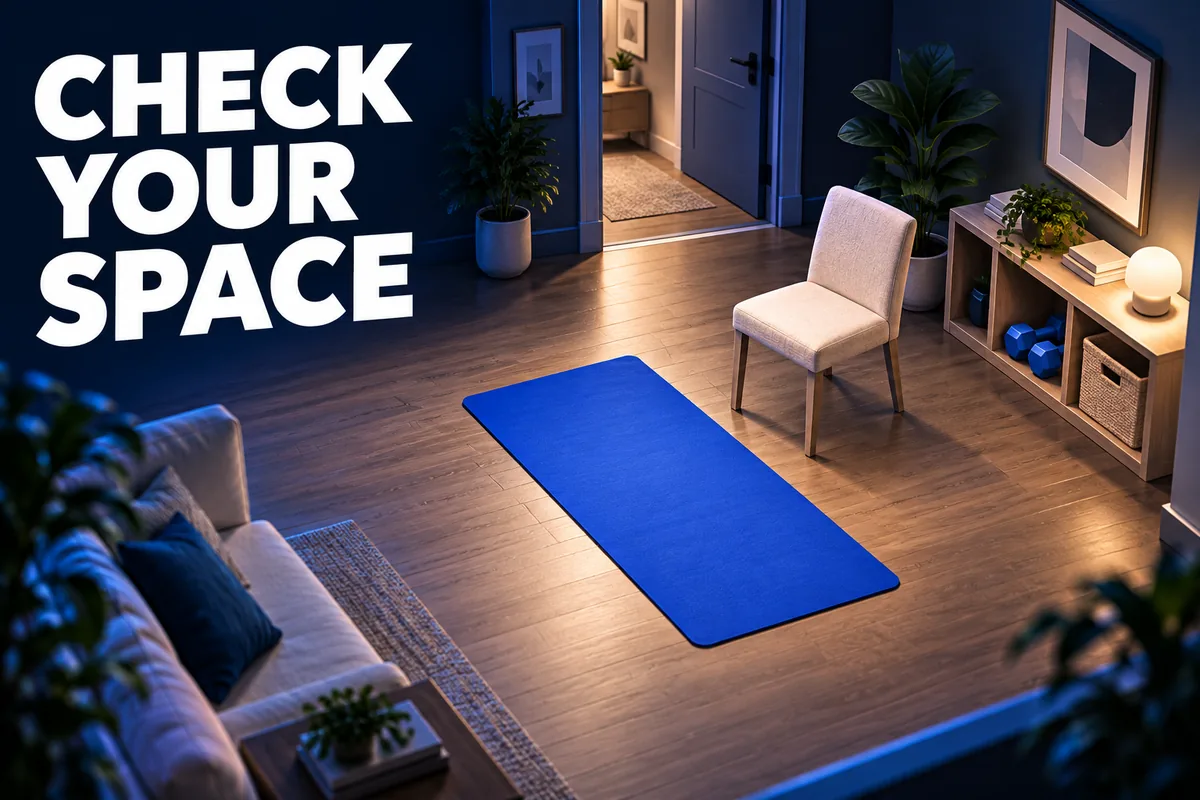
A small home workout space should fit the movements you intend to do, including getting into position and putting equipment away. A mat fitting between the sofa and table does not prove that your arms, feet or weights will clear them. Check the session before buying more equipment.
If your training space is temporary, pair the room check with a travel workout routine that adapts to time and equipment.
Check the movement, not just the mat
Clear loose objects, cables and anything that could roll under your feet. Check the space above you and the area a door sweeps through. Keep a clear route out of the room and agree with other people when the space will be in use.
Rehearse each planned movement slowly without a weight. Can you reach, bend and change position without touching furniture? Can you lower to the floor and get up comfortably? If an exercise does not fit, change the layout or choose a familiar alternative. Do not shorten an unfamiliar lift simply to miss a table.
The North Tees NHS home exercise advice specifically highlights surrounding space, opening doors and furniture that could topple. Its page originated during lockdown; the relevant points here are the physical setup checks.
Give each support its own check
Choose a firm surface with reliable grip. A mat can cushion floor contact, but it should lie flat without sliding or bunching. Test the actual surface with the footwear you plan to use. More cushioning is not automatically more stable.
For chair exercises, the NHS strength guide recommends a solid chair without wheels that will not slip. Your feet should reach the floor. Check the chair before sitting or using it for support. A chair suitable for sitting is not permission to use it as a step platform or weight bench.
For a wall movement, use a secure clear wall rather than a door, glass panel or movable partition. Our wall push up guide explains how foot position and body angle change the setup.
Separate movement from storage
Keep only the equipment you are using in the movement area. Put spare weights in stable storage outside your stepping and floor transition paths. Avoid balancing them on furniture edges or leaving round weights where they can roll.
Place the phone or screen on a stable support where you can read the instructions before a set. Keep charging cables outside the exercise area. Pause to check a demonstration rather than turning your neck toward a screen while lifting.
An exercise mat, a chair and weights do not all need to occupy the same patch at once. For example, finish the chair movement, put the chair safely aside, then prepare the floor exercise. That changeover also needs room.
Try one rehearsal before the workout
Walk through the first exercise, the transition and the next exercise without rushing. If a chair shifts, a mat creeps or you repeatedly step over equipment, stop and revise the setup. Check it again after anyone rearranges the room.
If noise is the main constraint, use our quiet apartment workout for controlled contact options. A mat alone does not make a room soundproof. If you own a suitable weight, the one dumbbell workout helps you check the space for each particular movement.
Leave a repeatable setup
After training, put equipment away, dry any slippery patches and restore the clear walking route. Keep a short note such as move the table, check the chair, place the screen. Photographing an empty setup for your own reference can help you recreate it.
There is no single room size that fits every body, exercise and piece of equipment. The useful test is whether your chosen session and transitions remain controlled in the space you have. Stop exercising for pain, dizziness or loss of control; seek individual advice if an injury or condition affects what you can do.