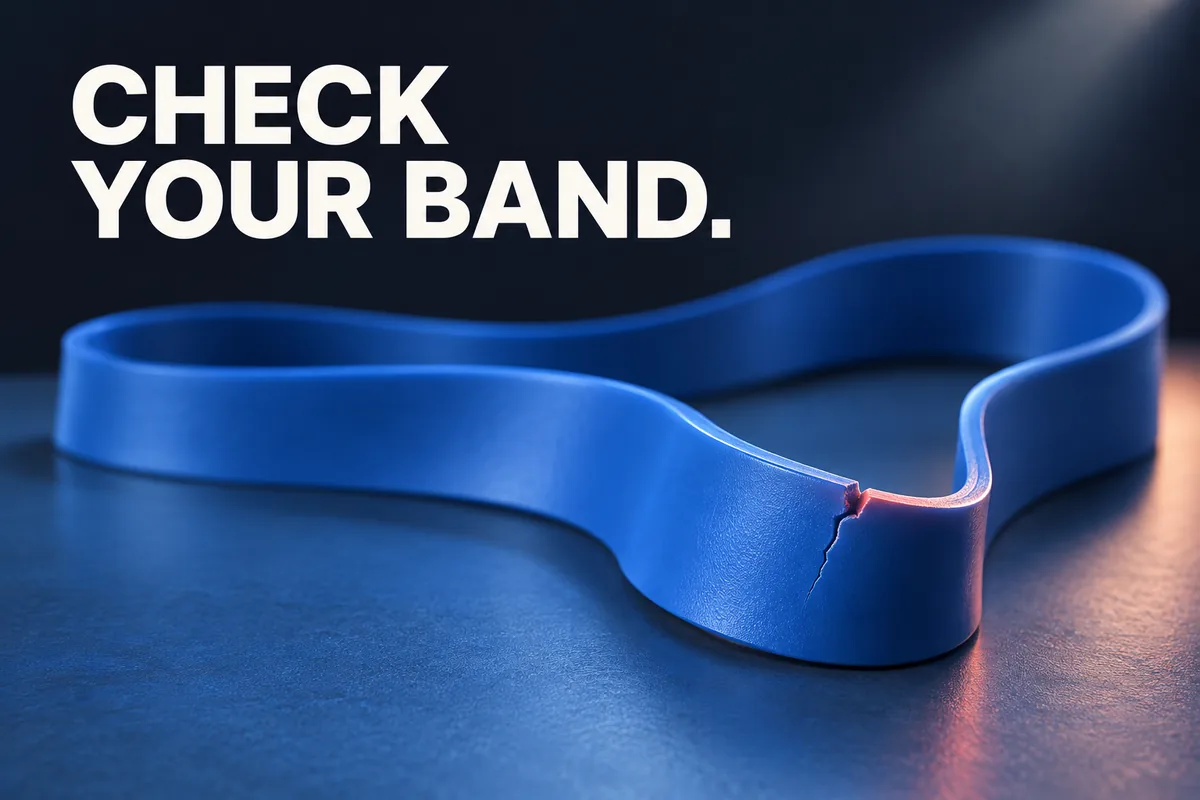
Identify your actual band
Before choosing a movement, identify the band or tubing and find its manufacturer instructions. A loop, a flat strip and a tube with handles may have different limits and attachments. Your home equipment plan should reflect usable equipment, not merely what is in the cupboard. Inspection does not certify hidden integrity.
Look before loading
With the elastic unloaded, look along its length, edges and the places that meet handles or attachments. THERABAND guidance calls for checking tears, abrasions and cracks, especially at connections. Look for nicks, punctures or worn areas too. Do not stretch damaged material to see whether it will hold.
Set suspect equipment aside
If you find damage or cannot establish its condition, stop using that band and arrange a suitable replacement. NHS safety advice says not to use flawed material. Tape, a new knot or a shorter section is not an inspection remedy. Change the planned exercise or equipment rather than loading a questionable band.
Check the connection and space
Use only the connection method and accessories permitted for that product. Check those parts according to their instructions before use. Clear sharp objects and keep people out of a possible recoil path. Follow the product's stretch limits and eye protection advice. Preparing a small training space remains a separate check.
Make the check repeatable
Inspect before each use, including after storage. Keep the band away from direct sunlight and extreme temperatures, and follow its own cleaning, drying and replacement directions. There is no single lifespan for every band. Once suitable equipment is ready, return to your planned band session without treating inspection as a guarantee against injury.