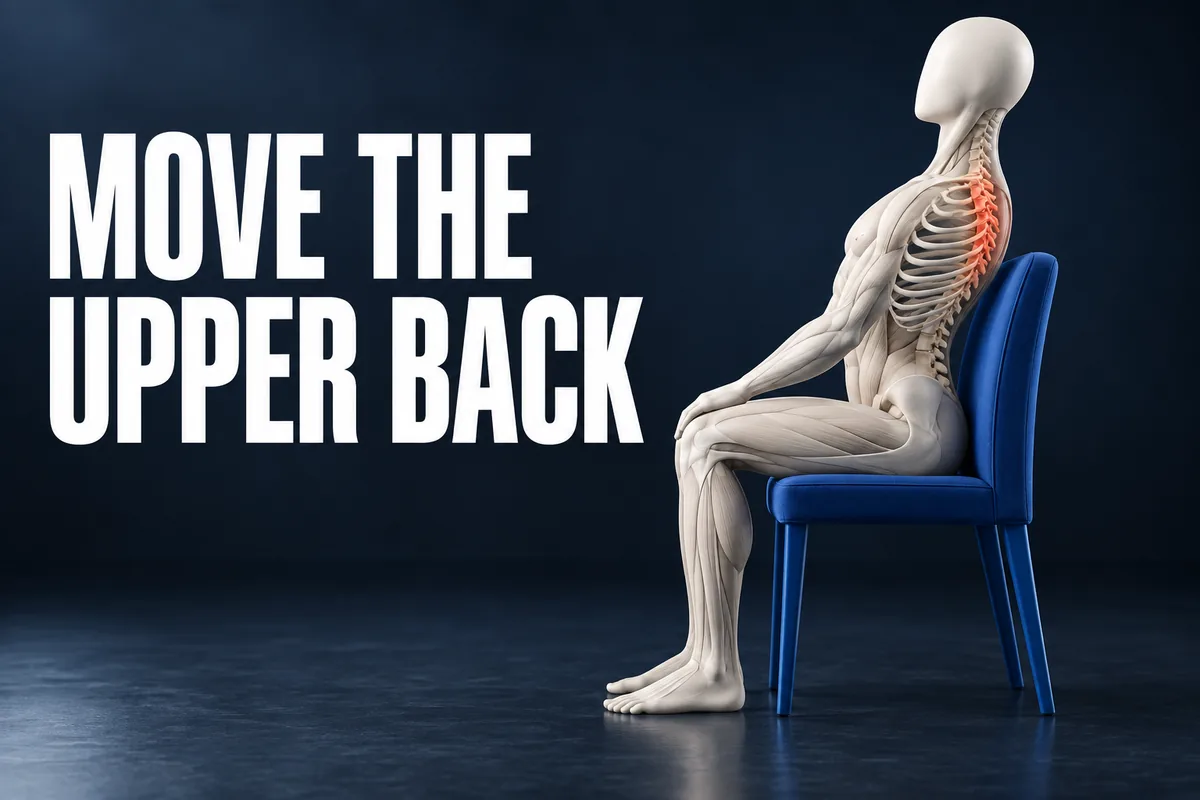
Seated thoracic extension is a backward movement through the upper and middle back. A chair gives you a clear contact point, but it should not push you into a large arch. Use a small comfortable motion and return with control. This is movement practice, not a test of posture or a treatment for pain.
Choose a firm chair
Use a sturdy chair without wheels. The back should be solid and high enough to contact your upper or middle back while your feet stay flat. Avoid a sharp edge. Sit far enough back to feel supported, with your knees comfortably bent and clear space around you.
The OPAL and South Tees NHS exercise page also uses a sturdy chair and begins in a seated position looking forward. Its hold time, repetition count and neck movement belong to that source. You do not need to copy them here.
Find the contact point
Cross your arms loosely over your chest or rest your hands where your shoulders stay relaxed. Let the chair touch the area you want to move. If the edge sits at your lower back, change the chair or your position. Do not slide down until the movement becomes a lower back arch.
Keep your feet in contact with the floor and your hips on the seat. Look forward with your neck comfortable. Take one calm breath before moving.
Make a small extension
Gently let your upper back move over the chair edge. Think of opening the front of the chest while the chair supports one part of the upper back. Stop well before strain. Then bring your trunk back to the starting position without using momentum.
Try one slow movement first. Decide whether the chair, contact point and arm position feel suitable. A smaller range with a clear return is more useful than a large movement that shifts into the neck or lower back.
Use three form checks
First, notice your feet and hips. If they lift or slide, reset the base. Second, notice the lower ribs. If they thrust forward while only the lower back arches, reduce the motion and adjust the contact point. Third, notice the neck. Keep it easy rather than throwing the head back.
There is no target angle and both sides do not need to feel identical. This movement does not diagnose stiffness or prove that posture has changed.
Compare the movement planes
Extension moves the upper back backward over the chair. Seated thoracic rotation practises turning. Seated side bend practises a sideways movement. Cat cow explores bending and extending from a supported floor position.
Choose the guide that matches the movement you want. Combining the names or chasing a larger range can hide where the motion actually occurs. The beginner mobility guide can help you choose one starting route.
Record comfort and control
After the attempt, note the chair, contact point and whether you returned smoothly. You can repeat the same setup on another day without treating the distance as a clinical score. If the chair changes, record that too.
Fitonomy Mobility describes guided movement, assessment and progress features on its current product page. Phone readings are fitness estimates, not clinical measurements. These article translations do not establish the languages available in the app.
Know when to stop
Stop if the movement causes pain, dizziness, tingling, numbness or instability. Do not push through a blocked or sharp feeling. A recent injury, surgery, osteoporosis concern or restriction from a clinician calls for individual guidance before this movement.
Your useful result may be simple: the chair was stable, the motion stayed in the upper back and the return felt controlled. That is enough information for one practice.