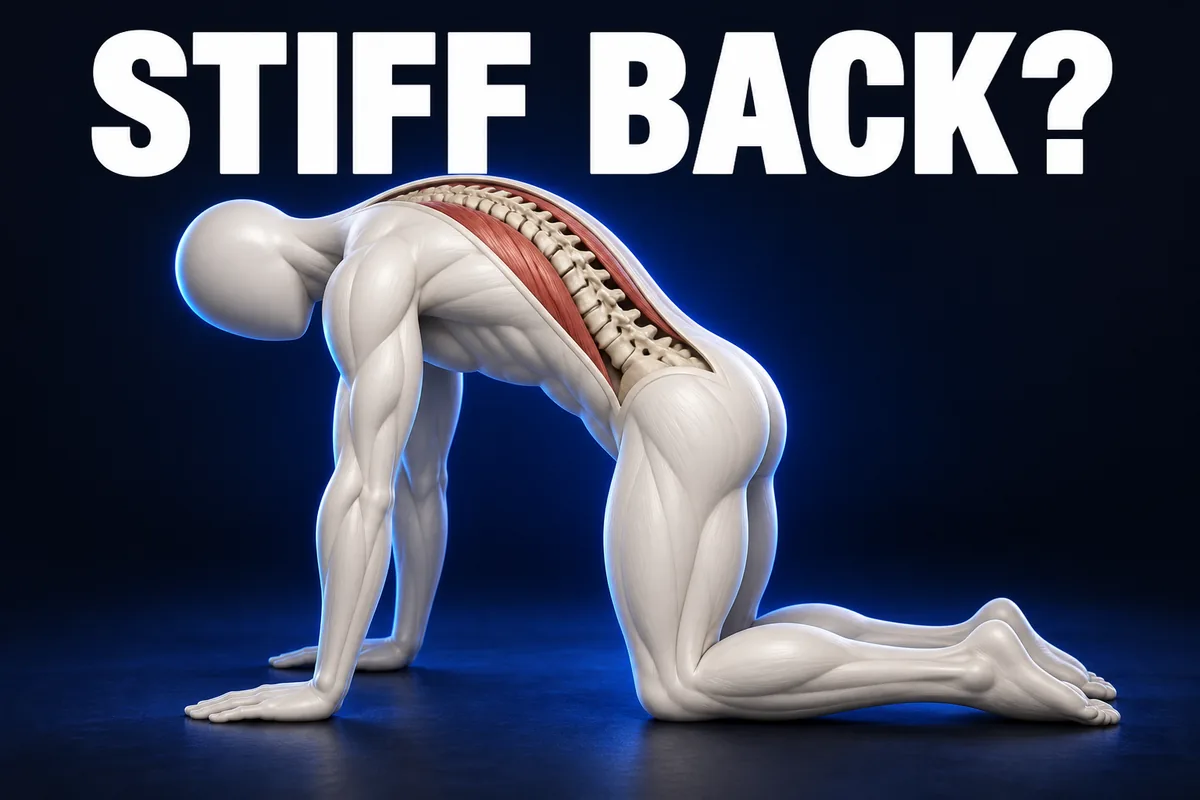
The cat cow stretch moves your spine between a gentle arch and a rounded position while your hands and knees support you. Think of it as controlled movement practice. The aim is a comfortable change of shape, not the biggest bend or a promise to fix back pain.
To decide where this floor movement fits in your week, use our beginner mobility guide. It explains how to choose a manageable first exercise, combine different movements and record control without making every session harder.
Set up on hands and knees
Use a mat on a firm, nonslip floor. Place your hands directly below your shoulders and your knees below your hips, with enough room to move freely. Start with a comfortable neutral back and let your neck follow the line of your spine.
Move slowly between the two positions
- Breathe in for cow. Gently tilt your pelvis and allow a small arch through your back. Let your head follow the movement without throwing it backward.
- Breathe out for cat. Draw your abdomen inward and round your back gently, allowing your head to lower with the curve rather than forcing your chin into your chest.
- Travel slowly between the positions. Keep your hands and knees in place and use a smaller movement if that makes the transition smoother.
Mayo Clinic’s cat cow demonstration pairs the two movements with breathing. The ACE cat cow guide also describes the setup and spinal positions. These sources present different holding patterns; a long hold is not required for the gentle flowing practice here.
Three checks for a comfortable practice
- If your neck is doing most of the movement, reduce the head motion and let it follow your back. Looking higher is not the goal.
- If the cow position becomes a strong lower back bend, make the arch smaller. In cat, avoid pushing for the highest possible rounded shape.
- A mat can cushion your knees, but padding does not make painful weight bearing acceptable. If your wrists or knees hurt under load, stop and ask about a suitable alternative instead of forcing the floor version.
Try a short first round
Three slow cycles can be an initial practice example, not a universal rehabilitation dose. One cycle means moving into cow and then cat. Return to neutral and rest. Use fewer cycles if comfort or control changes, and keep breathing naturally if matching the movement to a breath feels awkward.
Track the setup and the movement
Record the number of cycles, support used and one observation, such as kept the arch small or moved without rushing. Compare similar setups. A larger curve or a temporary feeling of looseness is not proof of a lasting mobility gain.
Cat cow explores bending and extending the spine. Our seated thoracic rotation guide covers a different movement, turning the upper trunk. Read mobility versus flexibility for context on movement control and range.
Fitonomy Mobility offers a fitness approach to movement practice. Its phone measurements are estimates rather than clinical readings. They do not diagnose back problems, and this exercise is not a substitute for individualized care.
Stop if the movement causes pain. If you have a recent injury, persistent symptoms or a condition that restricts spinal movement, get advice from a qualified clinician before trying this practice. Do not use the exercise to push through unexplained symptoms.
For rotation while staying on hands and knees, compare this bend and extend pattern with thread the needle for the upper back.
To explore a hip fold instead of a spine wave, see the quadruped hip rock back and keep the range comfortable.
For a seated upper back movement rather than a floor based spine wave, try gentle extension over a stable chair.