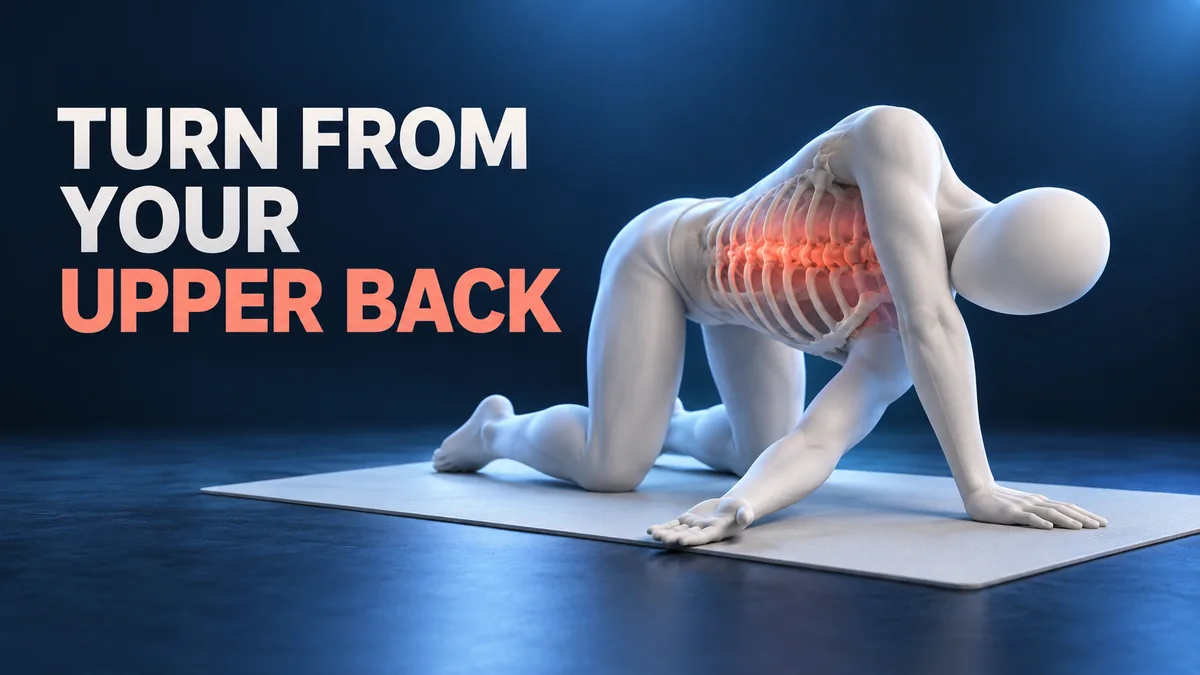
Thread the needle is a controlled upper back rotation on hands and knees. One arm travels under the other, then opens toward the ceiling. You can make either part small. This is movement practice, not a test of how far you can twist.
Set up on hands and knees
Place your hands roughly below your shoulders and knees below your hips on a stable surface. Spread your fingers and keep some weight through both knees. The Wrightington Wigan and Leigh NHS guide describes this four point starting position. Use a comfortable knee support if needed, but do not balance on an unstable cushion.
Reach underneath
Take one hand off the floor and guide that arm under the opposite armpit. Let your upper back turn a little while the supporting hand and both knees remain grounded. Do not drop your head or force your shoulder toward the floor. Pause where you can still breathe easily.
Return and open a little
Bring the reaching hand back through the centre. If comfortable, let it travel toward the ceiling while your chest follows a little. Keep your hips roughly facing the floor rather than rolling the whole body. The St George’s NHS movement sheet shows both the under reach and the opening, with room to use a smaller range.
Keep the motion comfortable
Move slowly enough that you can stop at any point. If your supporting wrist, shoulder or knee feels uncomfortable, shorten the reach or stop. Let your neck follow the body naturally rather than turning it sharply. You do not need a prescribed number of repetitions; a few smooth trials can tell you whether the pattern suits you.
Compare nearby movements
Cat cow on hands and knees bends and extends the spine, while this reach rotates the upper back. Seated upper back rotation uses a chair. Side lying open book rotation uses the floor on one side. The beginner mobility guide offers a broader sequence. Explore the Mobility app without assuming it supports every language of this article.
Stop if control or comfort fades
Stop for pain, dizziness, numbness or feeling unwell. Recent injury, surgery or prescribed movement restrictions call for personal advice before trying this exercise. These directions do not diagnose or treat a back condition, and a larger turn is not a guaranteed benefit.