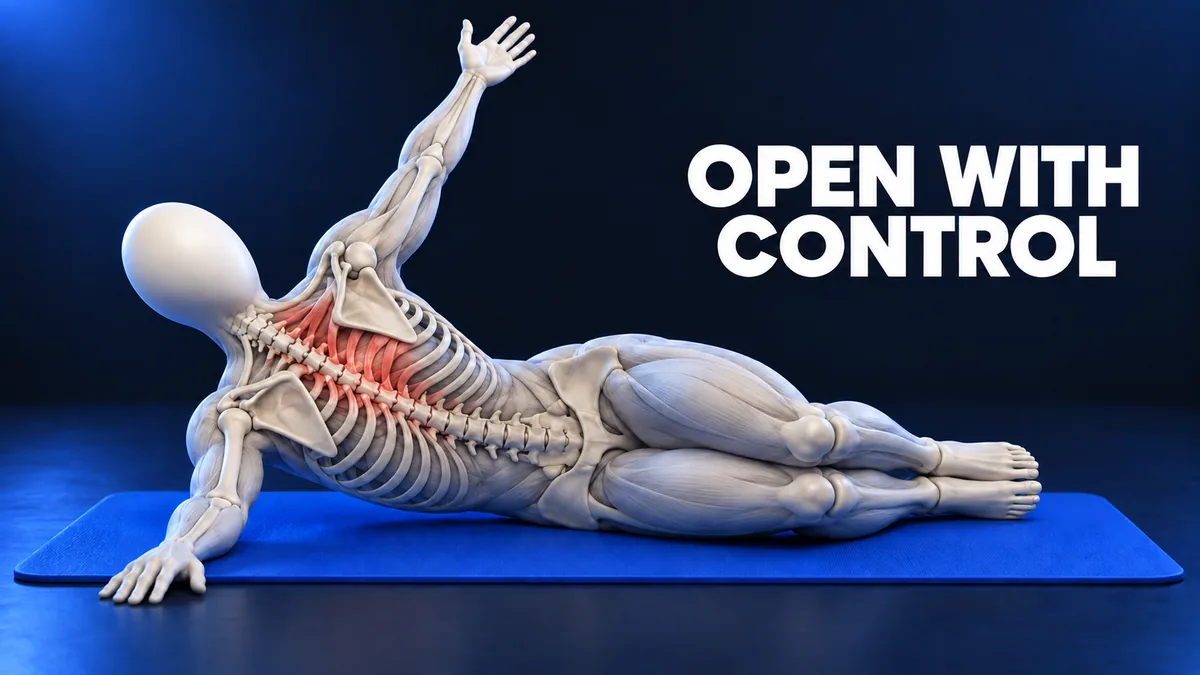
The open book is a side lying movement in which the upper arm and trunk turn while the bent knees stay together. A small, controlled arc is enough. This is a movement guide, not a treatment for pain.
What the open book moves
Your upper trunk follows the top arm as it opens away from the arm underneath. The knees stay stacked so the pelvis does not need to roll far. The ACE movement guide describes this setup in a clinical article; we use only its general movement cues, not its treatment claims.
Set up on your side
Lie on a comfortable mat with your head supported if needed. Bend both knees in front of the hips and keep one knee resting on the other. Reach both arms forward at about chest height with palms together. Give yourself room behind the top arm and keep the neck easy.
Open the top arm slowly
Lift the upper hand and let it travel in a gentle arc across your chest toward the space behind you. Turn your upper trunk only as far as feels comfortable. Keep the knees together rather than pulling the shoulder to the floor. The Leeds Teaching Hospitals instructions show the opening and return path.
Return with knees together
Bring the top arm back along the same easy path until the hands meet in front. Pause and notice whether the knees remained stacked and your breathing stayed comfortable. Try the other side if it suits you. No fixed distance or repetition count is needed for this general practice.
Compare nearby movement options
A seated upper back rotation starts upright in a chair. In supine knee rolls the knees move while the shoulders rest on the floor. The beginner mobility guide can help you choose one movement for a short routine. These are different setups, not interchangeable tests.
Respect your limits
Do not force the hand to the floor or pull the spine farther than you can control. Stop for pain, dizziness, numbness or loss of control. Recent injury, surgery or personal movement restrictions call for advice from your own clinician before a new drill. Mobility practice is not a diagnosis or treatment plan.