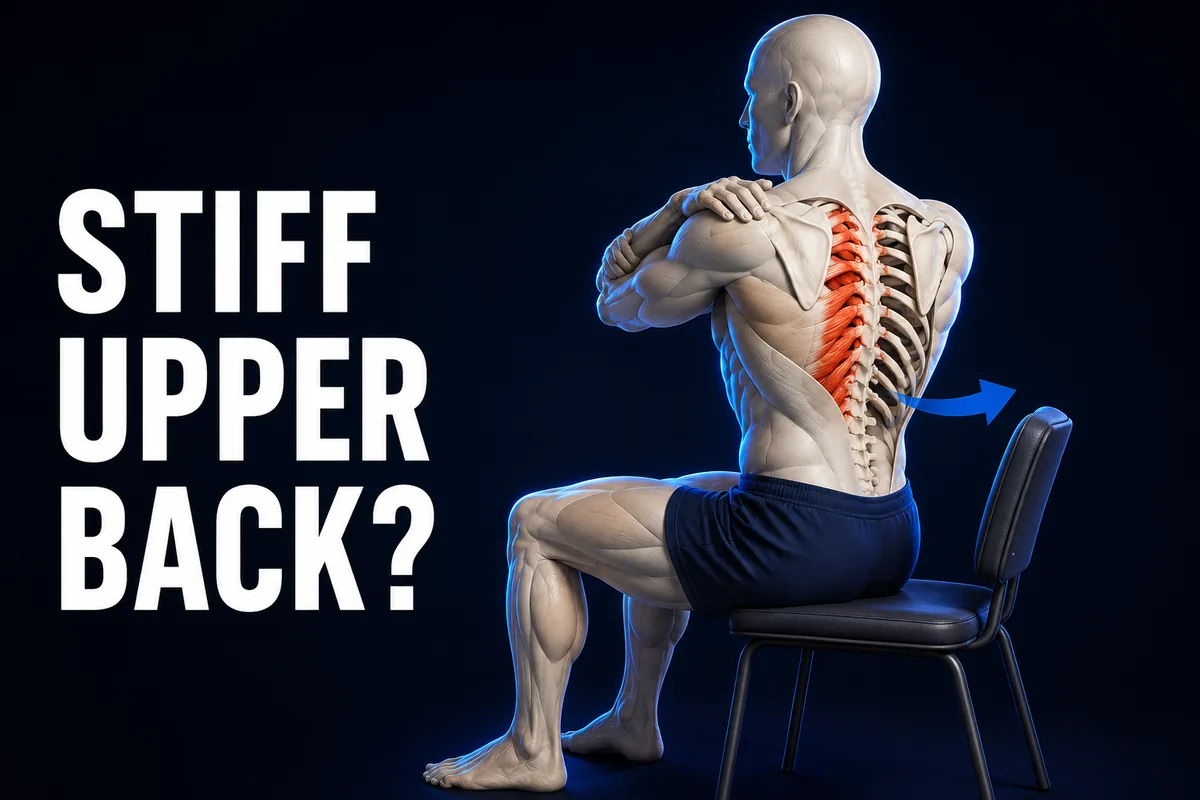
Seated thoracic rotation is a simple way to practice turning your upper body while keeping your hips steady. You need a stable chair and enough space for your shoulders. The aim is a comfortable, controlled turn, rather than reaching the largest possible angle.
For a sideways movement with both feet supported, try the seated side bend and keep both hips on the chair.
Use our beginner mobility guide to place this chair exercise in a small routine. If hands and knees are comfortable, cat cow is a separate option for gentle bending and extending of the spine rather than turning it.
Set up your chair
Use a solid chair without wheels, ideally without armrests. Sit upright with both feet flat and your knees comfortably bent. Cross your arms over your chest and rest your hands on opposite shoulders. Keep your sitting position steady.
How to do the movement
- Turn your chest gently to the left while keeping your hips facing forward. Let your head follow comfortably instead of pulling it farther around.
- Pause within a comfortable range, then return to the middle with control. Keep breathing normally.
- Repeat to the right. Use a smaller turn whenever you need it. Do not pull on the chair or bounce into a deeper twist.
The NHS chair exercise guidance gives an example of holding the turn for five seconds and repeating five times on each side. Build up gradually if that feels like too much. The example is a practice option, not a target to reach through pain.
Three form checks
- Are your hips turning too? Reduce the movement and keep your pelvis steady. Moving farther by swivelling in the chair changes the exercise.
- Are you only looking over your shoulder? Think about turning your chest, with your head following naturally.
Turning only your head is a different exercise. Our seated neck rotation guide explains that option with the shoulders and chest still.
- Are you holding your breath or straining? Ease the effort. A smaller comfortable movement is a useful place to practice.
When to stop or get guidance
Stop if the exercise causes pain. If you have an injury, recent surgery or a health condition that affects your spine, or you are unsure whether this movement is appropriate, ask your healthcare professional before trying it. AAOS guidance on spine exercise also stresses appropriate supervision and not ignoring pain.
Notice control, not a score
You can note whether the movement feels smooth and whether your hips stay still. Use the same chair and setup when comparing your experience over time. A difference between sides does not tell you its cause, and this exercise is not a diagnostic test or a clinical angle measurement.
For more context, read our guide to mobility and flexibility. Fitonomy Mobility offers guided movement routines; the app currently uses English. Its phone readings are fitness estimates. This chair exercise is one possible movement practice, not a promise to correct posture or treat back pain.
Learn a small upper back extension over a firm chair, keep the movement where you intend it, and return to neutral without forcing your neck or lower back. Seated Thoracic Extension With a Stable Chair
For the same upper back region from a side lying setup, see the open book rotation guide.
If a chair is not the right support, thread the needle on hands and knees offers a different controlled upper back turn.
To explore a small backward upper back movement instead of turning, see the seated chair extension guide.