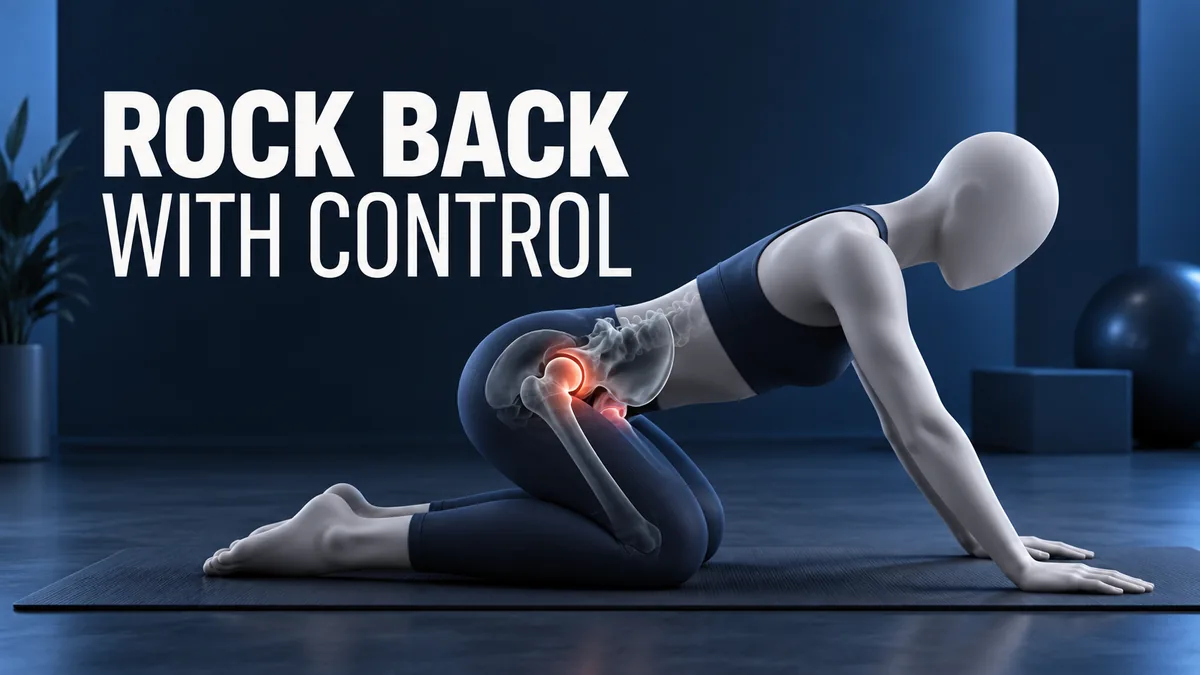
Set up on hands and knees
Place a mat under your knees and put your hands roughly beneath your shoulders. Position knees beneath your hips and spread your fingers for a comfortable base. Keep the starting back comfortably long, without forcing a rigid shape. The beginner mobility guide offers a broader starting point.
Shift the hips back gently
Move your hips a small distance toward your heels while your hands remain on the mat. Imagine folding at both hip joints rather than dropping your chest. The Summit Orthopedics movement description shows this backward path, but its rehabilitation sets and timing do not apply to a general movement break.
Notice when the back changes shape
Try to notice the point where your lower back starts to round or your pelvis tucks. You can turn around before that point if your goal is a quiet spine. The practitioner demonstration uses this observation as a control cue. There is no need to reach your heels.
Return and reset with control
Press lightly through your hands to return your hips above your knees. Pause, breathe normally and check that your wrists and knees still feel comfortable. Repeat a few easy movements if you wish, with enough space to notice each direction. Smaller range is still a valid movement.
Compare other joint paths
Cat Cow intentionally rounds and extends the spine, so it answers a different movement question. Hip Rotation for Beginners explores turning at the hip rather than rocking backward. Choose the path that matches the movement you want to practice.
Respect wrist knee and hip comfort
Pad the knees or change hand support if pressure is uncomfortable. Stop if you feel pinching, pain, numbness or dizziness. Skip this position if a current injury, surgery or personal restriction makes it unsuitable, and follow your clinician’s advice. The goal here is a comfortable, controlled movement, not a treatment promise.