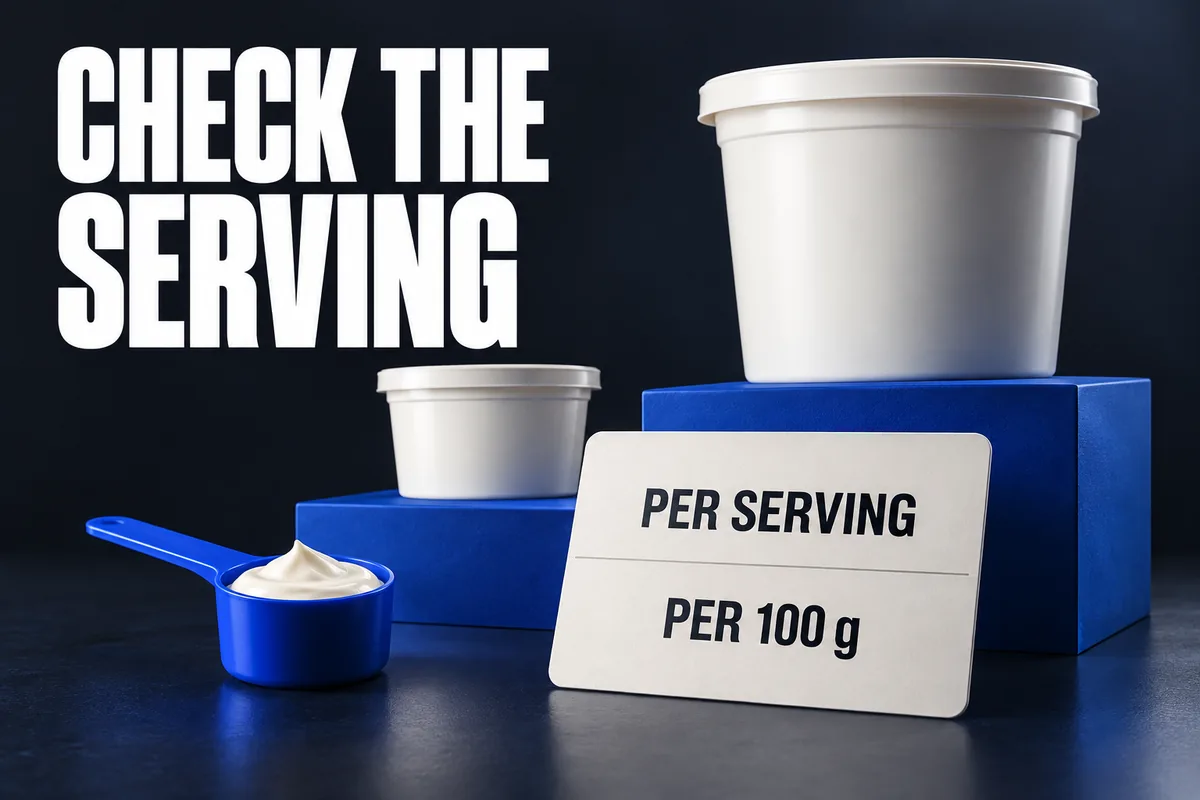
Two packages can advertise different protein amounts simply because their serving sizes differ. Start with the reference quantity, compare equal amounts, then calculate the portion you actually intend to eat. A larger number on the front does not answer all three questions.
Find the quantity behind the number
Read the nutrition panel beside the protein figure. Is it per serving, per 100 grams, per 100 millilitres, or per package? Also check how many servings the container holds. On a US Nutrition Facts label, the serving size describes a typical amount consumed, not your personal eating target. FDA guidance
UK labels give information per 100 grams or millilitres and may also show a portion. Other countries use different formats, so read the actual heading instead of assuming your familiar layout applies. NHS food label guidance
Work through two fictional labels
Imagine product A lists 12 grams of protein in a 150 gram serving. Product B lists 10 grams in 100 grams. These are invented numbers for arithmetic, not values for specific foods.
Product A contains 8 grams of protein per 100 grams: divide 12 by 150, then multiply by 100. Product B already uses that reference quantity and contains 10 grams. B has more protein at the same food weight, even though A displays the larger serving figure.
Now compare the portion. If you eat 150 grams, A provides 12 grams of protein and B provides 15 grams. This comparison does not establish that B is the better overall choice.
Calculate what you plan to eat
For a label expressed per 100 grams, multiply the protein figure by your portion weight and divide by 100. With the fictional product A, a 200 gram portion provides 16 grams of protein. Keep the units together; 200 grams of food is not 200 grams of protein.
For a label expressed per serving, multiply the listed protein by the number of servings eaten. Half a serving supplies half the listed amount. If the package contains two servings, eating all of it supplies twice that amount. Label rounding means the result is an estimate. FDA serving information
Make the comparison useful
Compare foods in the same stated condition. A dry weight, cooked weight and drained weight are not interchangeable. Check whether the label describes food as sold or after preparation. Do not silently add milk or another ingredient to a calculation that only describes the packaged food.
Check ingredients and allergens, price, taste and the other nutrients you care about. Protein alone cannot summarize a food or a meal. US protein labels do not always show a percent Daily Value; a missing percentage does not mean no protein. FDA label explanation
Use the result with your routine
Fitonomy describes meal planning and macro tracking alongside workouts. When recording food, check that the entry and quantity match your package and portion. Do not assume a similarly named product has the same values. Fitonomy nutrition features
Keep meal decisions alongside a realistic weekly workout plan. You do not need to turn label reading into a new protein target. If you follow a prescribed diet or need help with food restrictions, use individual professional advice.
A quick shopping check
Ask three questions: what quantity does this number describe, how does it compare at the same quantity, and how much will I actually eat? Save those answers for two foods you buy regularly. That is a practical comparison you can repeat without ranking every food by one nutrient.
Use a simple three part method to build a protein breakfast from ordinary foods, make practical swaps, and record the portion you actually eat. Build a Protein Breakfast Without Protein Powder