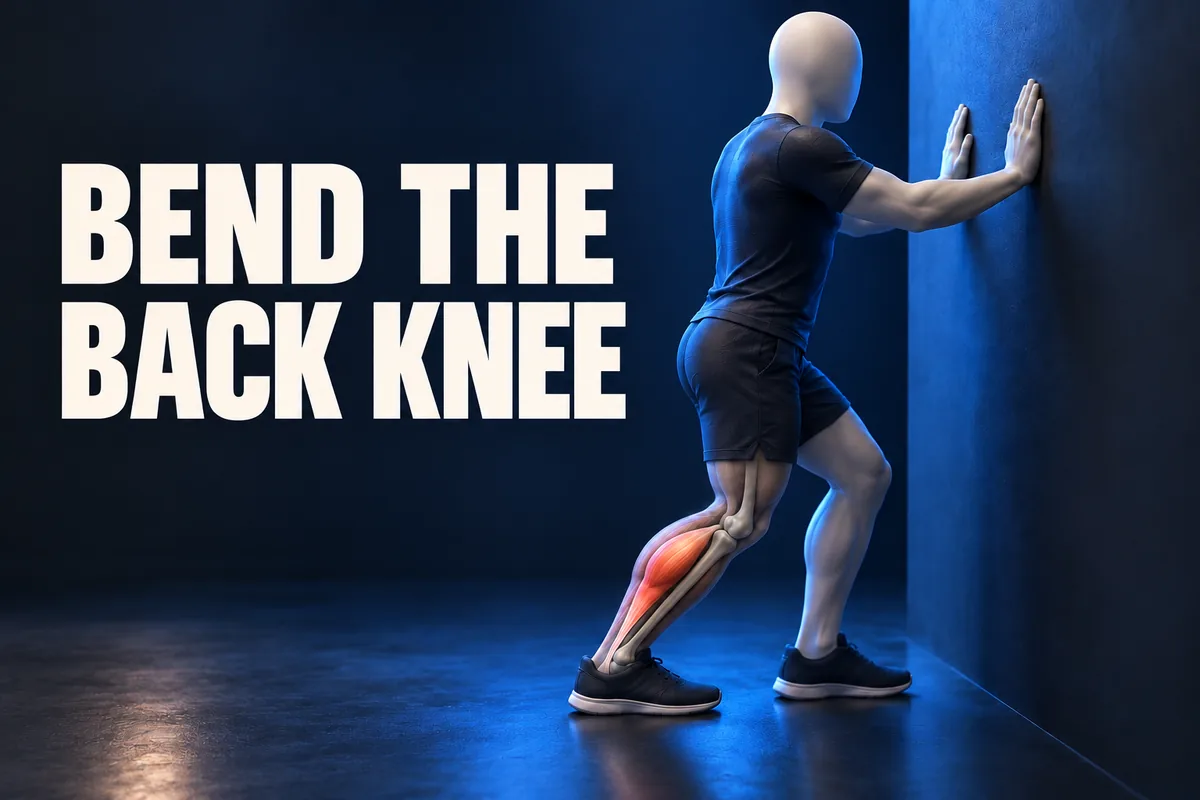
Find a secure wall position
Stand facing a solid wall on a floor that will not slip. Rest both hands lightly on the wall and place one foot behind the other with some width for balance. The Royal Orthopaedic Hospital guide shows this bent knee calf position. Its clinical hold schedule is not a requirement for every reader.
Bend the rear knee
Point the rear foot toward the wall and keep its heel flat. Bend that rear knee gently while the front knee also stays comfortably bent. Move only until you notice a mild stretch low in the rear calf. The AAOS exercise guide also illustrates the bent rear knee with both heels grounded. Do not chase a precise knee angle.
Keep the heel and breath quiet
If the rear heel lifts, shorten the stance or ease the bend. Keep your hips centered and breathe without bouncing. Release smoothly and switch sides only if the first position was comfortable. Stop if pain, tingling or balance loss appears. Recent injury or a personal movement restriction needs individual advice.
Compare the two wall tasks
The straight knee calf stretch keeps the rear knee straight and asks a different calf question. The knee to wall ankle check measures how the front shin travels and is not this held rear calf stretch. Do not compare their distances as if they were one test.
Record a repeatable setup
Note which foot was behind, the support, footwear and whether the heel stayed down. A mild, controlled attempt is enough; a deeper position does not prove lasting progress. The mobility progress journal helps keep observations separate from diagnoses. Explore Fitonomy Mobility for movement practice without assuming its app interface matches every article language.
For an active heel lift instead of this held heel down stretch, try the supported bent knee heel raise and lower both heels slowly.
For a different knee position, compare this wall movement with the seated towel calf stretch, which uses a towel around the front of the foot.