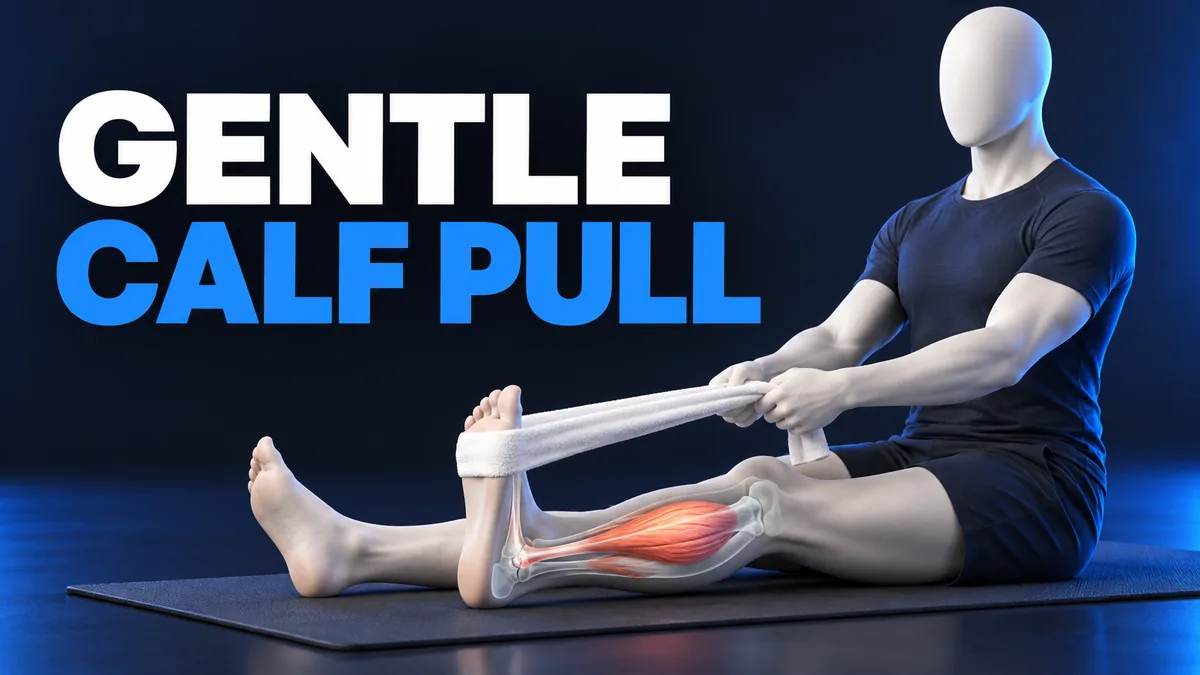
Choose the seated version
The towel gives you a way to guide the foot while seated. It differs from the standing calf stretch, where a wall and body position guide the movement. The AAOS foot and ankle guide shows the towel around the ball of the foot with the leg extended. Treat this as a gentle movement option, not a treatment plan.
Find a stable seat
Sit on a firm surface or mat with one leg comfortably forward. Keep your torso upright enough to breathe normally and let the other leg rest in a position that suits you. The working knee may be as straight as is comfortable, without forcing it flat. Do not pull if you cannot stay balanced in this position.
Place the towel
Loop the middle of a towel around the ball of the working foot, below the toes. Hold one end in each hand and check that the fabric will not slip. The NHS towel stretch instructions show a seated straight leg and a towel around the foot. Keep the toes roughly aligned with the knee rather than twisting the ankle inward or outward.
Pull and release gently
Draw the towel ends toward your body until the foot tips back slightly and you notice a mild stretch in the calf. Do not yank the towel or chase a larger range. Breathe, then ease the pull and let the foot return slowly. The source programs include clinical timing, but this general article does not prescribe a universal hold or treatment dose. Stop if the sensation turns painful, sharp or tingly.
Adjust the movement
If the towel feels awkward, try less pull or a different position. The bent knee wall calf stretch changes the knee position, while seated heel and toe raises use active ankle movement instead of a held pull. If symptoms persist or you are recovering from an injury, ask an appropriate clinician what is suitable. Explore movement ideas in the Mobility app.