Confirm permission for this exact task
Only use assisted hook flexion if your hand therapist has personally taught and cleared it for you. Cambridge University Hospitals warns that starting passive finger exercises too soon after injury can affect healing. Follow your own surgery, splint and movement restrictions. This explanation does not authorize a new stretch or treat stiffness.
Find the three finger joints
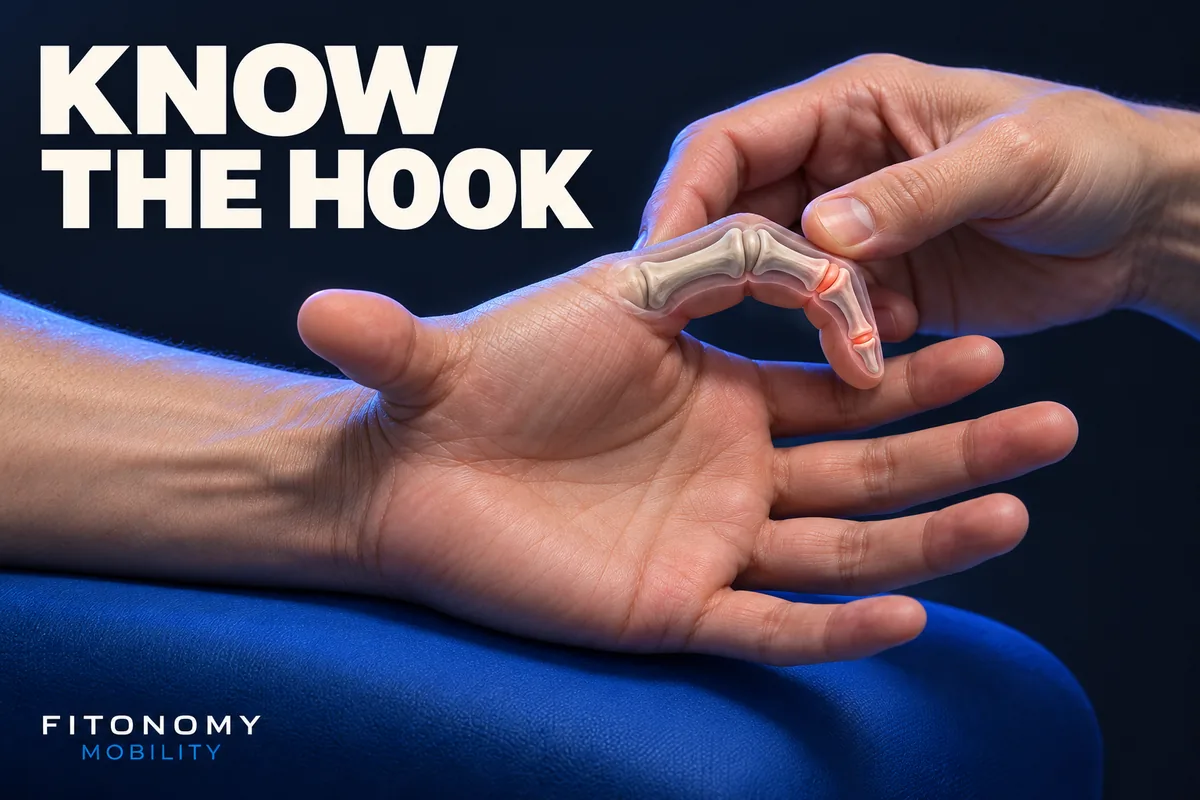
The large knuckle at the finger’s base is the MCP. The next joint is the PIP, and the joint near the nail is the DIP. A hook curls the middle and end joints while the base knuckle stays straight. It does not mean bending only the middle finger or making a full fist into the palm.
Clarify the assisting contact
Cambridge describes the opposite hand helping the top two joints curl. Ask your therapist to show the exact contact, support and comfortable stopping point for your finger. Move slowly as taught and release gently. Do not pull the fingertip, push to a maximum angle or copy pressure from the cover. Your clinician decides range, hold, repetitions and frequency.
Separate active and assisted movement
In active tendon glides, the fingers form the hook using their own movement without the other hand forcing it. An isolated middle joint bend is another task. Assisted finger extension straightens instead of curling. Permission for one does not clear the others; adding assistance is not an automatic progression.
Record instructions rather than an angle score
Note the finger, taught contact, support, personal dose and comfort. Stop for pain, numbness, new swelling, locking or loss of control and seek individual advice. Do not repeat the movement to test a symptom. Read the beginner mobility guide for context. Fitonomy Mobility does not provide clinical clearance; article translations do not establish the app’s available languages.
This hook keeps the base knuckle straighter. A separately taught assisted bend at the base targets the MCP instead; do not transfer the hook’s contact or permission to that movement.