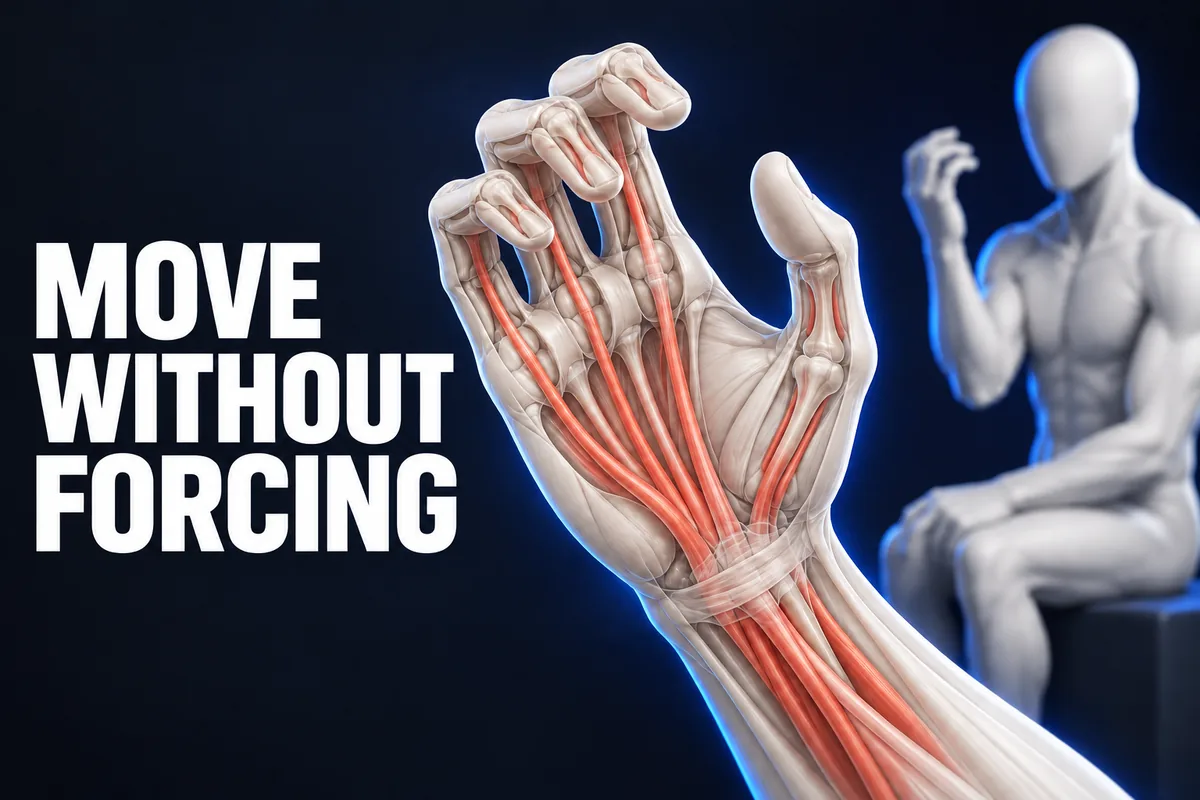
Finger tendon glides are a sequence of hand shapes that change how the finger flexor tendons move relative to one another and nearby tissue. They are commonly used in hand therapy, so the shapes can be explained generally while the reason, timing and dose may need individual guidance.
Separate finger movement from wrist movement
The North Tees hand therapy guide begins with the wrist and large knuckles controlled while the finger joints form different shapes. Keep the forearm supported and the wrist near neutral so the fingers, rather than the whole wrist, create the movement.
Learn four useful shapes
Begin with an open relaxed hand. For a hook, keep the large knuckles straighter while bending the middle and end joints. For a full fist, roll the fingers gently toward the palm. For a table shape, bend the large knuckles while keeping the other joints straighter. For a straight fist, bend the large and middle knuckles while the fingertips reach toward the palm.
Move slowly and release fully
Use a comfortable effort rather than squeezing hard. Pause briefly in each clear shape, then open the hand without snapping the fingers straight. One careful cycle can be enough to learn the order. The movement should stay smooth and should not require the other hand to force the joints.
Know what the anatomy evidence means
An in vivo PubMed tendon study examined forty eight hands and found that a straight fist, hook and full fist produced different relative gliding between the two main finger flexor tendons and nearby structures. This supports the idea that the shapes are mechanically different. It does not prove that an unsupervised routine treats pain, swelling, locking or an injury.
Keep therapy instructions individual
The Cambridge hand exercise guide explains several active finger positions and leaves repetition frequency blank for a clinician to prescribe. If a therapist gave you an order, splint rule or limit after injury or surgery, follow that plan instead of copying a general sequence from the internet.
Compare finger shapes with the separate seated wrist mobility guide and use the beginner mobility guide to choose a short, manageable practice. A larger motion is not automatically a better one.
Ask for help when the hand needs it
Stop if the movement causes sharp or increasing pain, new numbness, marked swelling, repeated locking or loss of control. Recent trauma, tendon repair, fracture, surgery, a new splint or uncertainty about allowed movement calls for advice from a qualified hand therapist or clinician.
Support the forearm, move the thumb to each fingertip, and use light contact while the wrist stays quiet. Thumb Opposition: Touch Each Fingertip With Control
For a palm down task that lifts one digit rather than forming whole hand shapes, see Lift One Finger at a Time From a Table .
Hand shapes differ from moving the fingers apart and together with the palm resting on a table; keep these movement tasks separate.
If your hand therapist approves work on one end joint, the supported fingertip bend explains its own powered movement separately from these whole hand shapes.