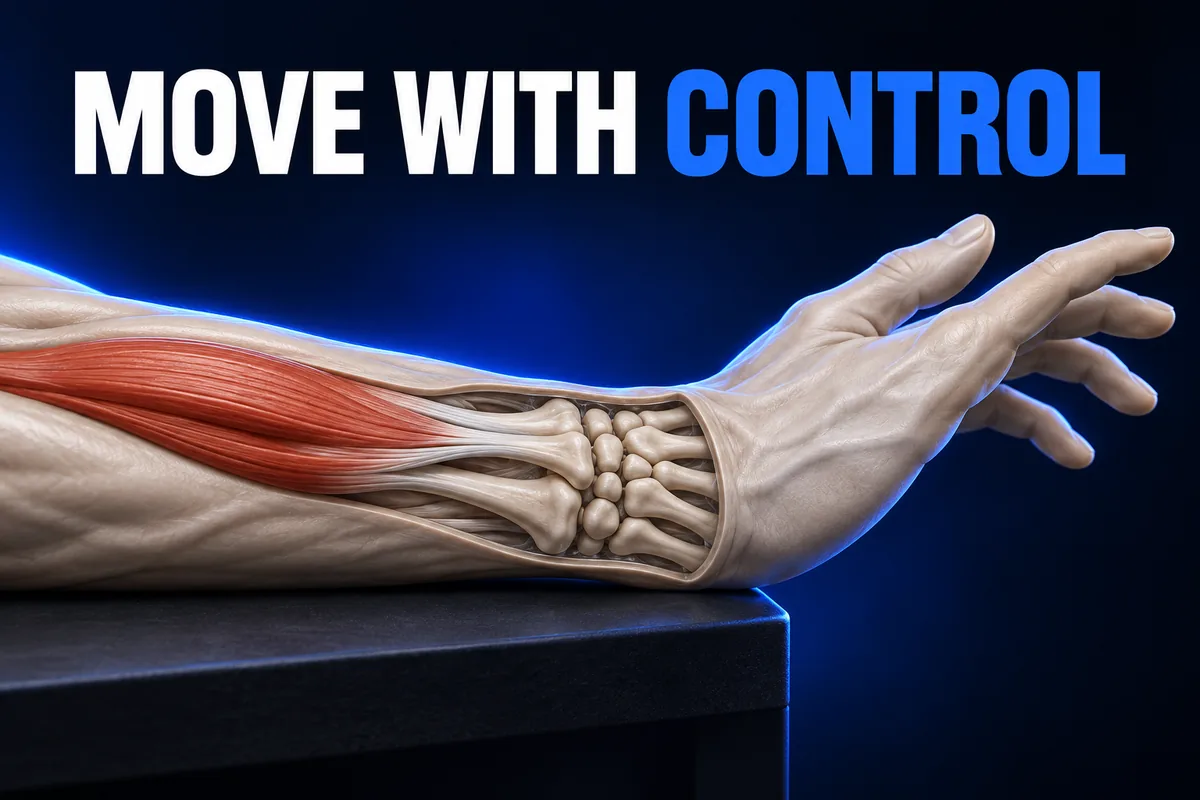
Seated wrist mobility can start with two simple actions: bending the wrist and turning the forearm. Keep the movements slow and comfortable. You do not need to lean your bodyweight onto your hands or pull your fingers back to begin exploring active movement.
Active movement is different from a forced stretch
Here, active means that you move the hand using your own muscles. Your other hand does not push it farther. Turning the palm up and down is mainly forearm rotation, so it should not be treated as the same movement as bending the wrist. Our mobility and flexibility guide explains that distinction between control and externally assisted range.
Support the forearm first
Sit beside a stable table with your shoulder relaxed. Place your forearm on the surface, palm down, with the wrist just beyond the edge so the hand can move freely. A small folded towel can make the support comfortable. Avoid pressing the edge into the wrist crease.
Bend the wrist without lifting the arm
Slowly let the hand move down, then lift it up within a comfortable range. Keep your forearm resting on the table and your fingers relaxed. Return through the middle without bouncing. The South Tees wrist movement guide illustrates this supported setup. A small controlled movement is enough to start; do not chase the biggest angle in a picture.
Turn the palm without twisting your torso
For a separate movement, bring your elbow beside your body and bend it to roughly a right angle. Slowly turn the palm up, then down. Let the forearm rotate while the elbow stays near your side. Leeds Teaching Hospitals shows this position. Avoid moving your shoulder or turning your whole body to make the hand travel farther.
Try a brief practice and reassess
As an introductory example, make three slow wrist bends and three palm turns on each side, then rest. Use fewer or a smaller range if needed. This is a way to learn the movements, not a rehabilitation dose or a required daily target. Hospital exercise leaflets include patient programmes; their frequency should not replace your own clinician’s instructions after injury or surgery.
Notice what changes the movement
- A rising forearm changes the wrist bend. Reset the support before counting another repetition.
- A tightly clenched fist adds unnecessary effort for this practice. Let the fingers soften without forcing them straight.
- Pressure from the opposite hand changes the task into an assisted stretch. Keep this practice active and unforced.
Track comfort and control
Record which movement you tried, the number of comfortable repetitions and whether the arm stayed supported. Use the same setup next time. A difference between sides or a temporary increase in range is not a diagnosis or proof of lasting progress. Fitonomy Mobility uses phone based fitness estimates, not clinical measurements; this article does not define a wrist score or a normal angle.
When to stop
To focus on finger shapes while the wrist stays quiet, use the finger tendon glide guide.
Stop if movement causes pain, tingling, numbness or increasing discomfort. After a recent injury, swelling, surgery or prescribed immobilisation, check with your clinician before starting. Do not force a stiff joint or use this routine to treat unexplained symptoms. For a separate gentle upper body movement, see our seated rotation guide.
Turn the forearm through a comfortable path while the wrist, elbow and torso stay quiet. Seated Forearm Rotation From Palm Down to Palm Up
For a different direction with the palm on a table, explore sideways wrist movement while the forearm and elbow stay supported.