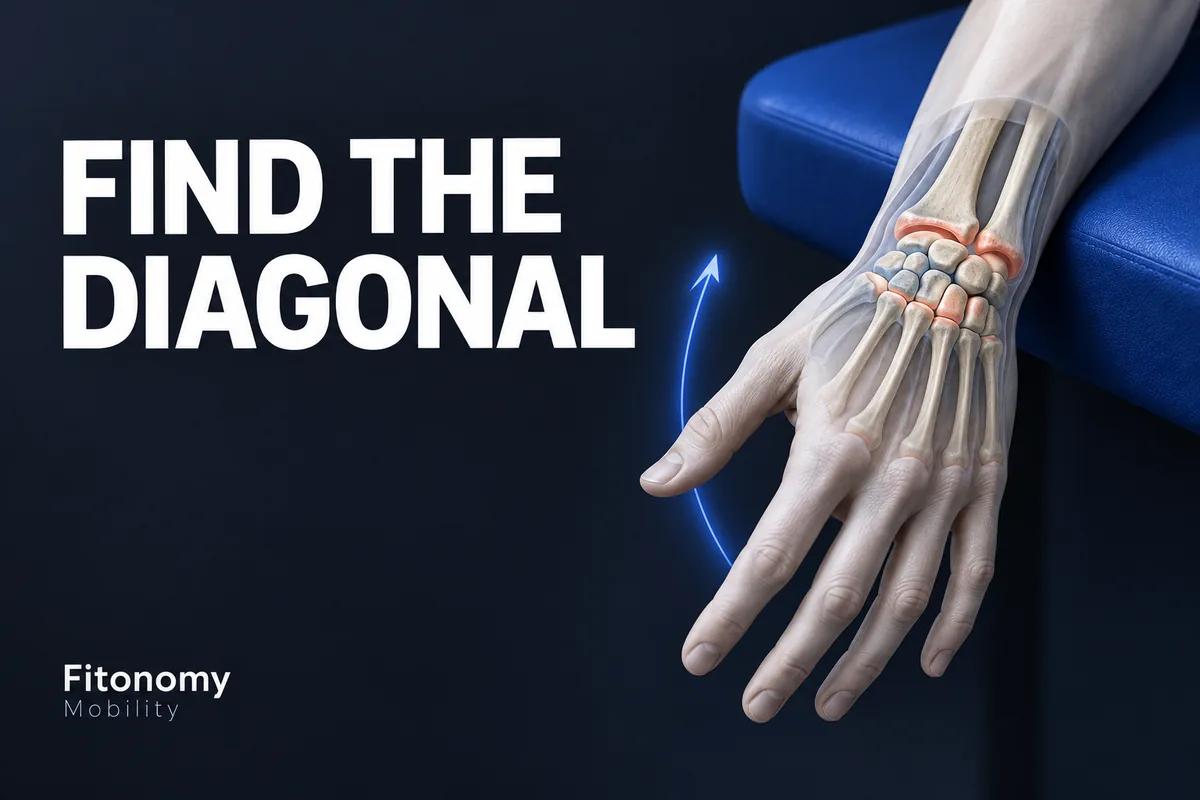
Choose a supported setup
This guide is for comfortable, unrestricted movement, not injury rehabilitation. Sit at a stable table with the elbow and forearm supported and the hand free to move beyond the edge. Relax the fingers. The St George wrist leaflet permits imagining a pen rather than holding one. Here you move using your own muscles, without the other hand pushing.
Move back toward the thumb
Begin with the hand roughly in line with the forearm. Make a small movement that combines bending the wrist backward with moving toward the thumb side. The IFSSH biomechanics report calls this radial extension. Use only a comfortable path. Do not lift the whole arm or clench a fist to make the movement larger.
Move forward toward the little finger
Return gently through the middle, then bend the wrist forward while moving toward the little finger side. The Sussex leaflet describes these two diagonal endpoints. This is a slow wrist exploration, not a throwing action. Reverse smoothly without snapping or forcing the end position. Try a brief comfortable exploration and pause; no universal repetitions or rehabilitation schedule are prescribed here.
Keep the movements distinct
Straight wrist bends in the seated wrist guide and flat sideways movement in the table guide separate these directions. Forearm rotation turns the palm instead. If the shoulder or elbow carries the hand, reset and use a smaller diagonal. Record the setup and comfort, not a target angle or diagnosis. Return to the beginner guide to choose another movement.
Respect symptoms and restrictions
Stop for pain, tingling, numbness or swelling. After injury, surgery, a splint or prescribed restrictions, get individual advice before trying this motion. The CLCH symptom guide advises urgent help for extreme pain or swelling, unusual shape or colour, lost feeling or difficulty moving. Clinical leaflets do not grant universal permission or prove ligament protection. Explore Fitonomy Mobility for movement practice; article languages do not imply matching app interface languages.