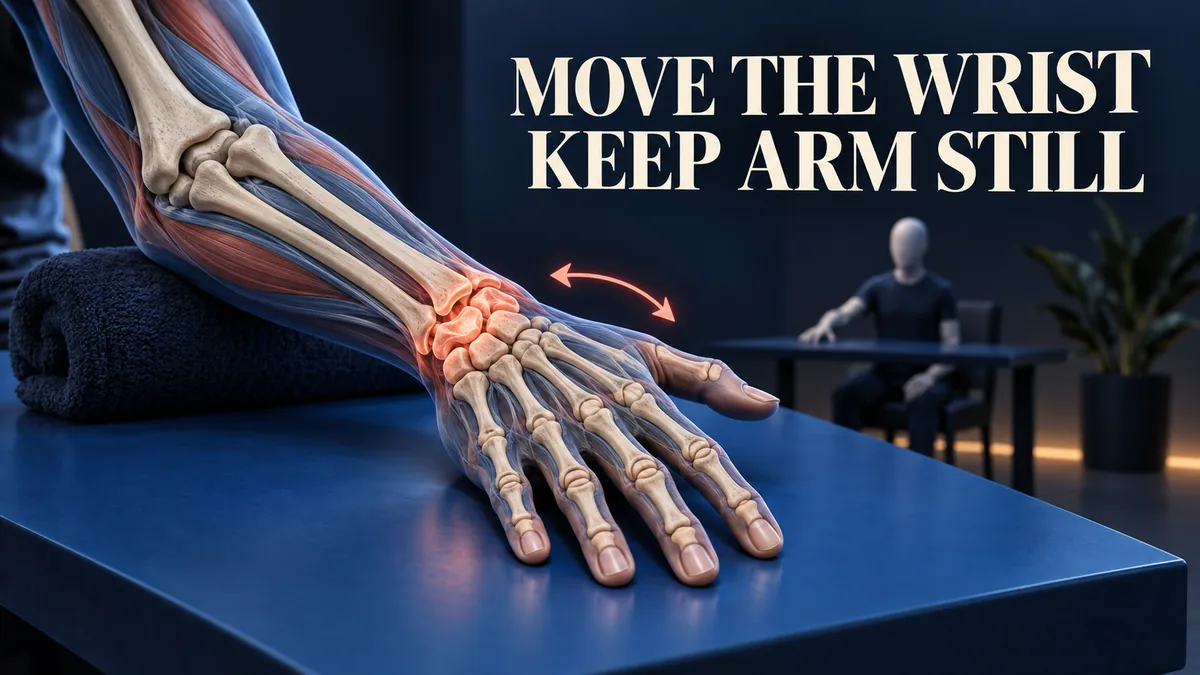
Set up a supported arm
Sit beside a table at a comfortable height. Rest the forearm and hand palm down, with relaxed fingers. Keep the elbow supported and the shoulder easy. The Kent wrist movement guide describes moving the wrist sideways on a table without moving the elbow. Choose a surface where the hand can slide gently.
Move toward the thumb
Start with the hand roughly in line with the forearm. Move the hand a small distance toward the thumb side, using your own wrist muscles. This direction is called radial deviation in the Cambridge active wrist guide. Stay within a comfortable range. The aim is a clear movement, not the largest angle.
Return and explore the other side
Bring the hand back toward the middle, then move gently toward the little finger side. This is ulnar deviation. Return without rushing. Do not pull with the other hand, add a weight or press through resistance. Try a brief exploration, then pause; this article does not prescribe a rehabilitation dose.
Watch what stays still
Check whether the forearm, elbow or shoulder travels with the hand. If the whole arm slides, reduce the wrist movement and reset the support. The table exercise instructions keep the elbow still. A small controlled path is more useful for this task than a larger motion made by the shoulder.
Respect symptoms and restrictions
Stop for pain, numbness, tingling, swelling or other concerning symptoms. Do not use this guide to test an injury. After an injury, surgery or a period in a splint, follow your clinician’s individual advice. The source pages include clinical exercise instructions; their repetition schedules are not a universal routine for every reader.
Keep the directions distinct
Sideways wrist movement differs from bending the wrist up and down in the seated wrist guide and turning the forearm in the forearm rotation guide. Use the beginner mobility guide to choose familiar movements. If you record a practice, note the setup and comfort rather than chasing a score.