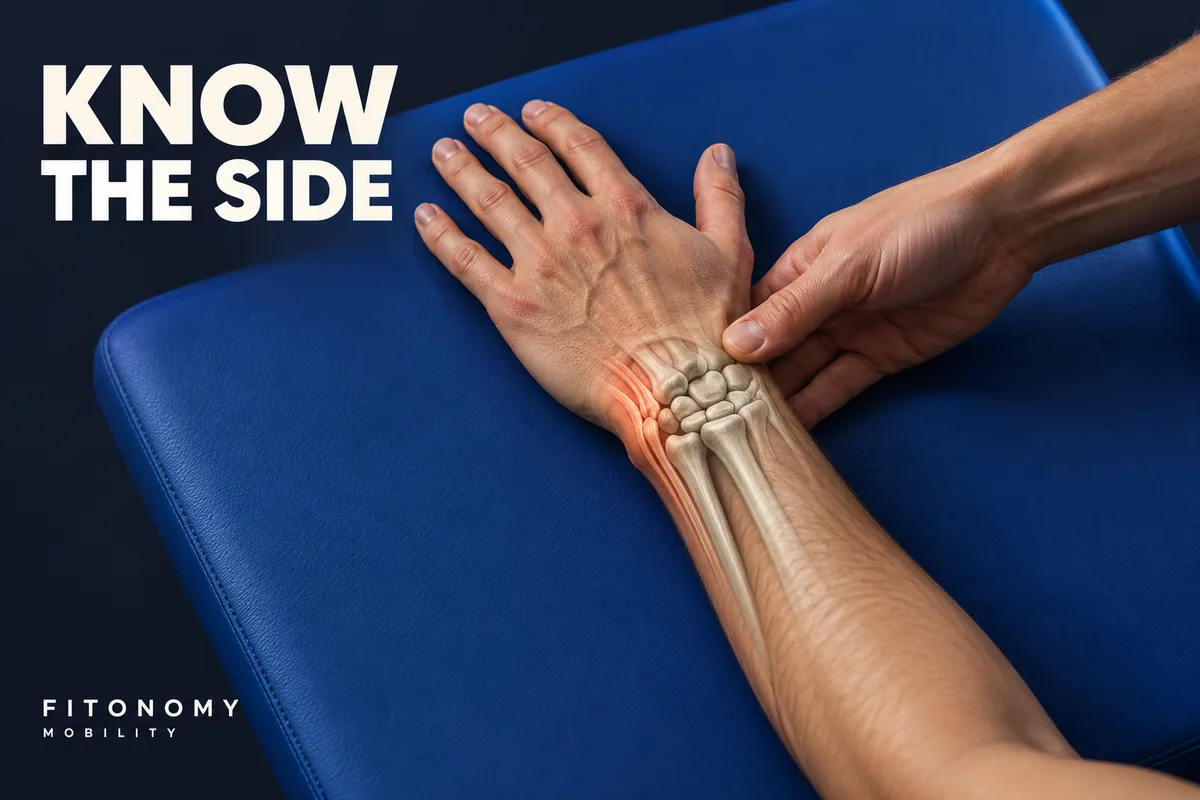
Confirm personal instruction for this direction
Only use this movement if your hand therapist has personally taught and cleared it for you. Guy’s and St Thomas’ guidance says to follow the therapist’s exercise choices and frequency. Surgery, splint and movement restrictions come first. Permission for another wrist exercise does not clear this one.
Find the little finger side
The Cambridge passive wrist leaflet describes the hand palm down on a table, with the other hand guiding the wrist sideways toward the little finger. The whole hand changes its line relative to the forearm. This is ulnar deviation, not bending the little finger, lifting the hand or turning the palm upward.
Clarify support and other hand contact
Ask your therapist to confirm forearm support, exact assisting contact and your comfortable stopping point. Move slowly as taught and release gently. Do not pull fingertips, press with body weight or copy pressure from a picture. Range, hold, repetitions and frequency remain individual; do not combine schedules from different leaflets.
Separate the neighboring movements
Active sideways practice uses the moving hand’s own muscles without opposite hand pressure. Assisted thumbward movement goes the other way. Wrist bends and palm turns are different tasks. Do not add assistance to an active routine as an automatic progression.
Record instructions and respect symptoms
Note the side, taught setup, contact, restrictions and comfort. Stop for pain, tingling, numbness, swelling or loss of control and seek individual advice. Do not repeat to test a symptom or chase an angle score. The beginner guide gives context. Fitonomy Mobility does not provide clinical clearance; translated articles do not establish the app’s available languages.