Confirm your personal instructions
Use this guide only if a physiotherapist has personally taught and cleared this exact assisted movement. The WHH ankle leaflet is a rehabilitation guide that requires prior instruction. It does not authorize self treatment of unexplained stiffness. Follow your own position, contact, range and schedule. The beginner guide helps organize suitable tasks, not provide clinical clearance.
Recognise the supported position
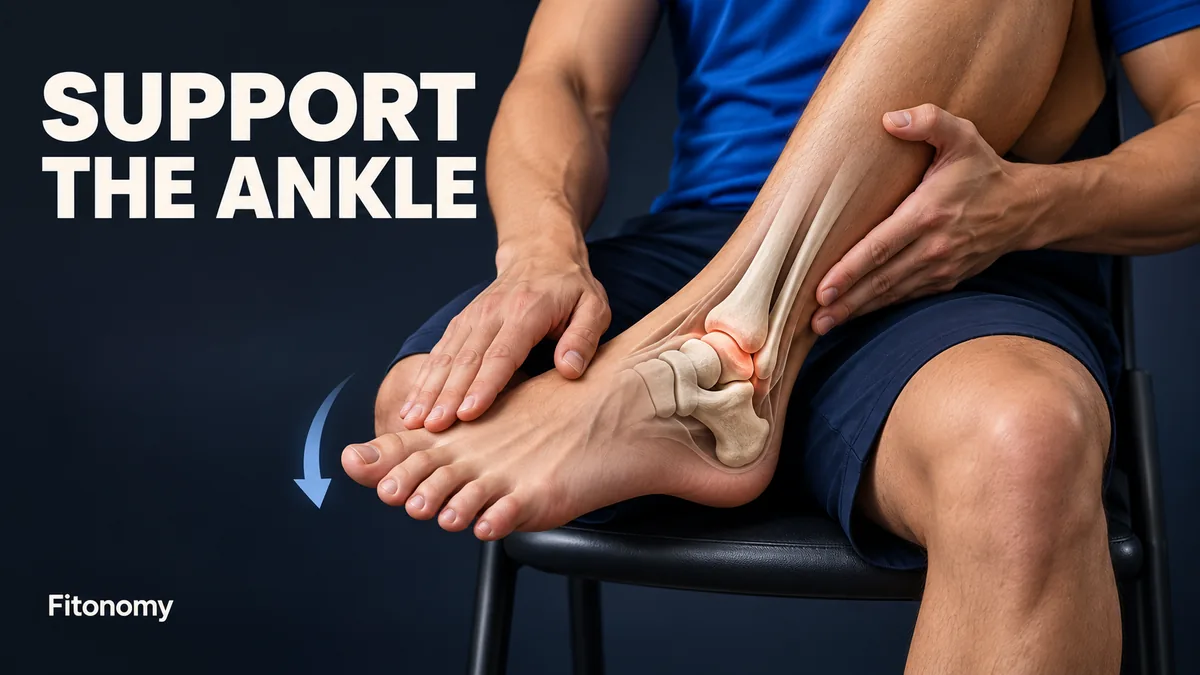
The seated example places the working ankle across the opposite knee. Use it only if that matches your teaching and your hip and knee are comfortable. Keep the leg supported and foot within easy reach. Do not pull the leg into place or twist to reach it. Ask for another demonstration if the position does not fit.
Clarify contact and ankle direction
The Burn Care Network leaflet shows hand contact on top of the foot to assist a downward point away from the shin. Confirm your own hand contact and amount of help with your clinician. The ankle moves the whole foot; this is not yanking the toe tips or curling only the toes. Ease off and return gently. That source concerns burn rehabilitation and its listed review date has passed; its treatment claims and schedule are not adopted here.
Separate nearby tasks
Assisted toe extension bends toe joints upward. Active side turns turn the foot inward and outward. Heel and toe raises use active movement with floor contact. Do not add hand force to those tasks, combine their schedules or use a picture's angle as a target. No universal hold or count is prescribed.
Record and respect symptoms
Note the side, support and personal instructions rather than a guessed normal angle. Stop for pain, numbness, new swelling, unusual colour change or loss of control, and seek advice without repeating to test symptoms. Recent injury, surgery, burns, diabetes, reduced sensation or restrictions need individual guidance. No pain relief or walking benefit is promised. Article translations do not establish Fitonomy Mobility app languages.