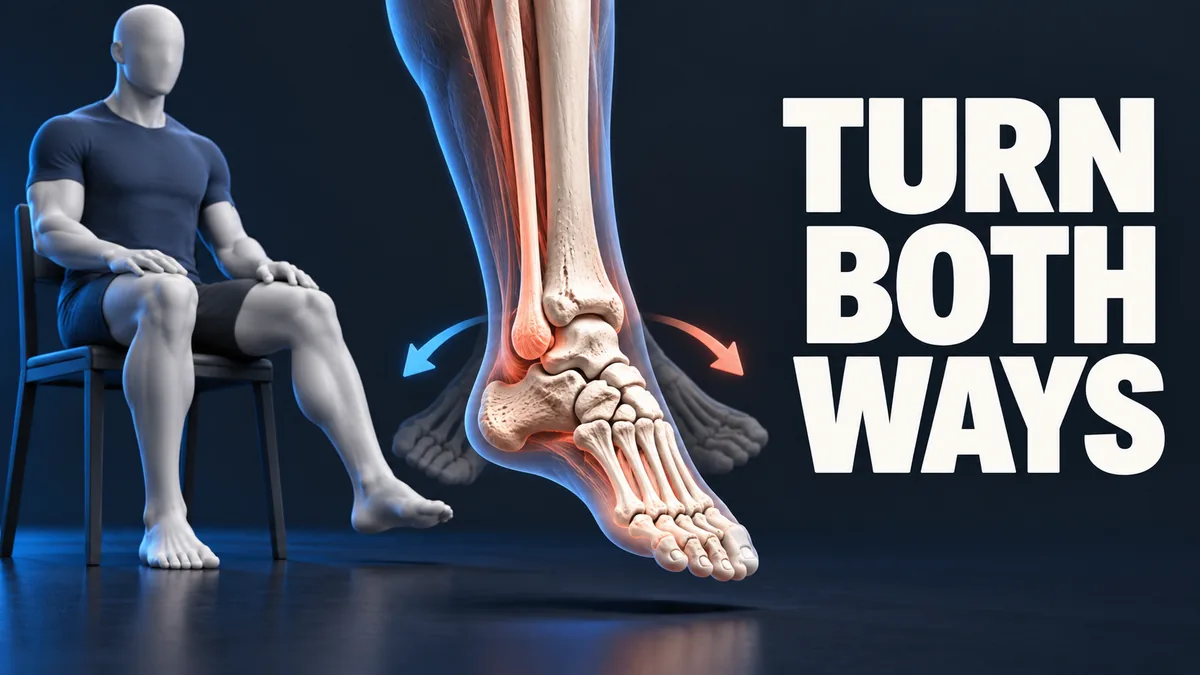
Ankle inversion turns the foot inward; eversion turns it outward. These are small side directions, different from pointing the toes up and down or drawing a continuous circle. The Leeds hospital guide and Newcastle hospital guide show the directions in clinical exercise pages. Here they inform general movement practice, not treatment or a rehabilitation schedule.
Choose a stable seat
Sit on a firm chair that does not roll. Clear the floor and keep one foot planted. Lift the other foot just clear of the floor or support the lower calf while leaving the foot free. Keep your trunk upright and the moving knee roughly still. There is no need to balance on one leg.
Turn inward and return
Move the free foot a small distance inward, toward the other foot, and return to a comfortable middle position. Watch the foot rather than pulling the whole knee across. Move slowly and do not force an end position. The Leeds guide describes this inward direction and the return.
Turn outward and return
From the middle, turn the same foot a small distance outward, away from the other foot, and come back with control. Let the toes relax instead of gripping them. The Newcastle guide names the inward and outward actions separately. Its clinical repetition schedule is not a general target here.
Keep the leg quiet
If the knee swings, the thigh turns or the trunk leans, make the foot path smaller. Notice whether one direction feels clearer today, without treating that observation as a diagnosis or measuring progress from one try. Put the foot down and rest whenever control changes.
Compare other ankle paths
Seated ankle circles trace a continuous loop. Seated heel and toe raises move the foot up and down while it contacts the floor. The knee to wall ankle check explores a separate loaded task. Pick the movement you mean to practise rather than mixing them into one score.
Respect your limits
Stop for pain, dizziness, new numbness, swelling or other concerning symptoms. With recent injury, surgery or clinician restrictions, follow your personal plan and ask if this movement is suitable. Do not add a band or weight for this first exploration. Fitonomy Mobility is a separate app and is currently in English.
Once side to side movement feels clear, the seated ankle alphabet combines several small directions.