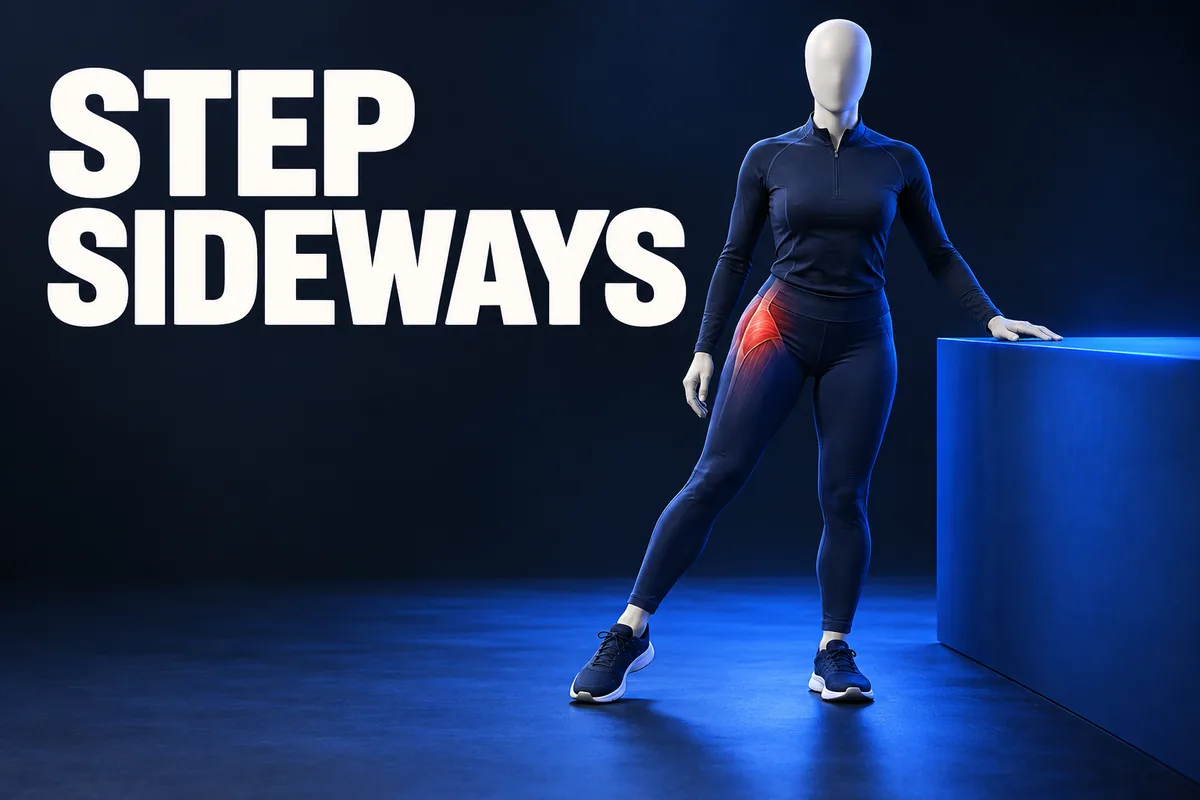
Choose a clear place
Find a level floor with enough space to either side and a fixed counter or secure rail that will not slide. Keep a hand where it can help without pulling your body sideways. The NHS sideways walking guide describes slow steps near a wall or stable support. This is a movement exploration, not a balance test or a prescription to complete a certain distance.
Feel a steady start
Stand comfortably with both feet on the floor and look ahead. Before moving a foot, notice that you can stand steadily with the support you chose. The supported weight shift guide practises this planted foot pressure without stepping. If even a small shift feels uncertain, stay with that stationary option or ask for individual guidance rather than forcing a step.
Move the first foot sideways
Take one small step to the side with the foot nearest your open space. Place the whole foot down and let your hips remain roughly level instead of throwing the trunk after it. The Cambridge NHS sideways walking sequence shows a lead foot moving out before the other foot joins it. Its rehabilitation schedule is not a general dose for this article.
Bring the other foot across
Once steady, move the trailing foot toward the lead foot without crossing your legs or rushing. Leave a comfortable space between your feet rather than trying to touch your shoes. The Leicestershire NHS movement sheet shows sideways travel and allows a handrail or stable surface when needed. Check that the support stays within reach throughout your chosen short path.
Reverse with room to move
Pause with both feet grounded, then use a small step in the other direction if the floor is clear. Keep eyes open and stop if you feel dizzy, painful or unsure of your balance. A supported side leg lift moves a free foot away and then returns it to the starting spot. In this step, both feet change location one after the other.
Choose the simpler movement when needed
You can stay beside the support and practise only one controlled step, or return to a stationary movement. The supported standing march lifts a bent knee but does not travel sideways. Neither movement needs a particular number of repetitions or a promised mobility gain. If you have a recent fall, injury or medical movement restriction, seek individual advice before copying a general routine.
When a sideways step feels comfortable, try supported tandem walking to explore forward foot placement with a counter in reach.
Side steps travel laterally. The backward steps beside a counter guide describes a separate direction and its clear path check.
For a different forward task, small supported toe steps keep the heels raised while travelling rather than moving sideways with flat feet.
If separate side steps feel steady and crossing is suitable for you, compare a supported front cross and uncross as a different optional movement.