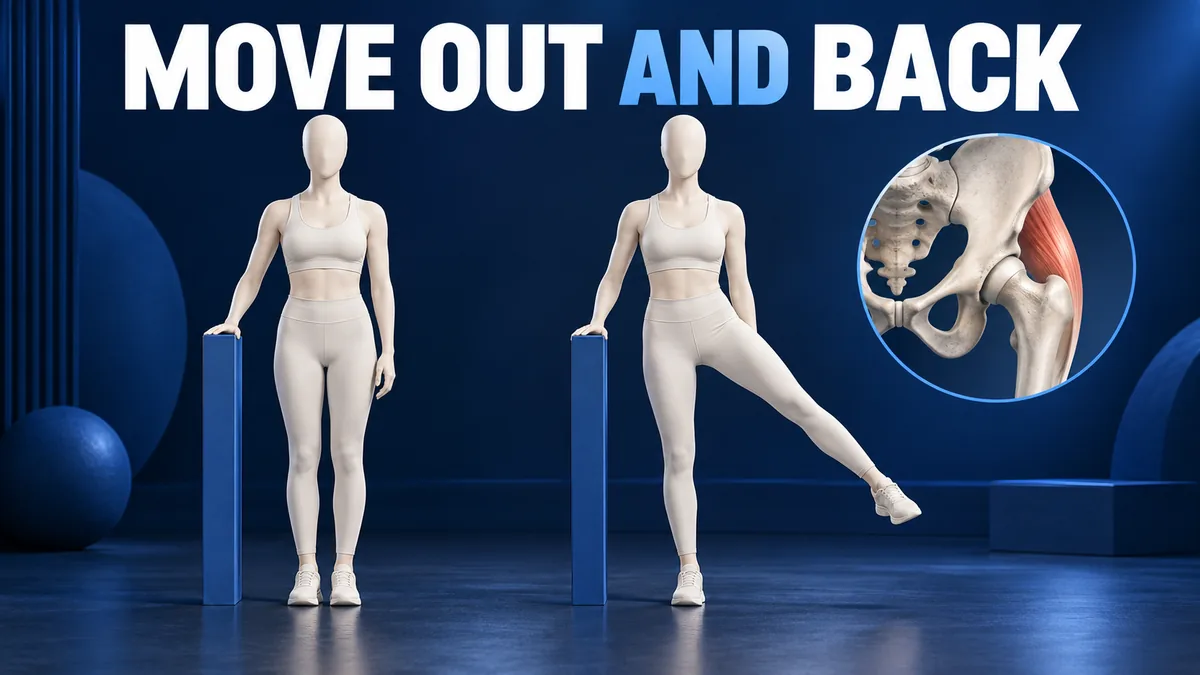
This movement takes one leg to the side at the hip. The goal is a clear controlled path, not the largest possible range.
Choose stable support
Stand beside a firm support with clear floor space. Rest a hand lightly, point both feet forward, and keep your trunk tall. Use more hand support if balance is uncertain.
Move out slowly
Shift enough weight onto the standing leg to feel steady. Move the other leg a small distance to the side without turning the toes. The South Tees NHS guide also emphasizes support, forward toes, and slow control.
Keep the pelvis quiet
Stop before the pelvis lifts, the trunk leans, or the leg swings. The Cambridge NHS guide describes the movement while avoiding pelvic twist and back bending. A smaller clean path is useful.
Return with control
Bring the foot back at the same pace. The Sussex NHS guide also describes stable support, a straight back, a side lift, and a return to the ground. Do not drop the foot or force the range.
Observe and stop when needed
Compare sides only while stable and comfortable. The hip rotation guide and seated hip marching use different directions. Stop for pain, dizziness, numbness, tingling, instability, or symptoms that persist. Record observations in Fitonomy Mobility without diagnosing.
For a bent knee rotation while lying down, read the steady pelvis clam guide; it asks for a different path from this standing side lift.
To explore a different hip direction with support, move the leg gently backward while avoiding a forward lean or an arched back.
For a supported sideways path while lying on your back, compare the straight leg slide; its support demands differ from this standing lift.
For a smaller standing task that keeps both feet down, the supported side weight shift explores pressure transfer before a leg lift.
For actual sideways travel rather than a leg lift in place, the supported side step guide moves both feet in sequence.