Confirm this exact task
This guide is for adults personally taught and cleared for an unassisted prone knee bend. The Plymouth hospital source places it within Achilles rehabilitation with boot instructions. Its weeks and angle are not general permission. Keep any prescribed boot or brace instructions; this illustration does not authorize removing equipment.
Understand the support
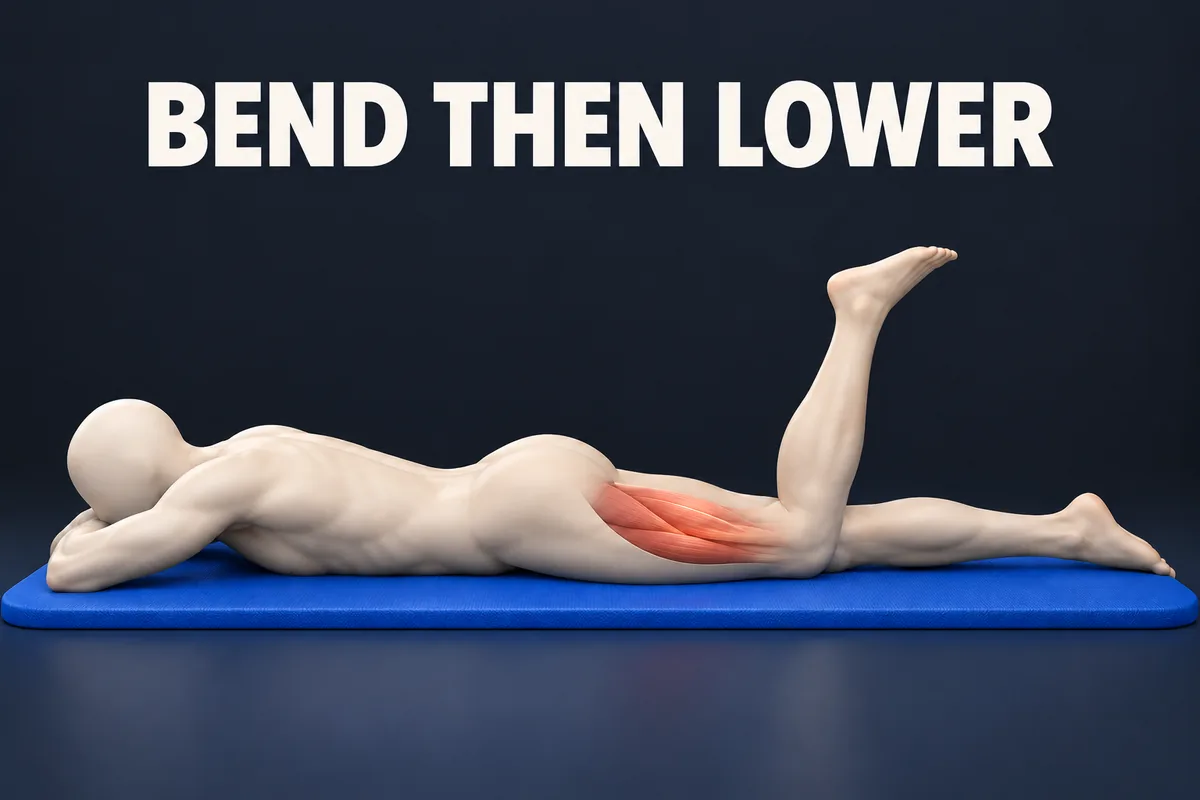
Prone means lying on your front. Use the surface, head support and safe way to get into position that your clinician demonstrated. The thigh rests on the surface while the lower leg moves. If lying this way, breathing comfortably or getting back up is uncertain, ask for individual guidance first.
Bend without adding a pull
Use your own muscles to bend the knee through your personally taught range. The heel rises as the lower leg approaches the thigh. Do not lift the whole thigh or pull the ankle toward your seat. The CUH assisted version uses a towel in a different rehabilitation context; do not borrow that assistance.
Lower with control
Return the lower leg slowly as demonstrated, keeping the thigh supported. No universal angle, hold or repetition count applies here. Standing knee bending uses a standing base; a heel slide keeps the heel on a surface. These are different tasks, not automatic progressions.
Record and stop safely
Note the position, permitted equipment, side, comfortable range and personal dose. Stop for pain, swelling, tingling or loss of control and seek advice. Records do not diagnose recovery. The beginner mobility guide helps organize movement practice. Fitonomy Mobility does not replace clinical clearance, and article translations do not establish app language support.
If separately taught and cleared, compare the straight knee prone hip lift: the whole leg rises instead of bending the knee while the thigh rests.
If separately taught and cleared, compare a prone hip turn with the knee kept bent; the foot moves sideways rather than repeatedly bending the knee.