Check whether this fits today
This is comfortable movement practice, not treatment. Skip it with vertigo, neck pain, recent injury, surgery, a collar or movement restrictions, and seek individual advice. NHS vertigo guidance specifically cautions against neck stretching during vertigo. The beginner guide helps choose a different suitable task.
Settle into an upright seat
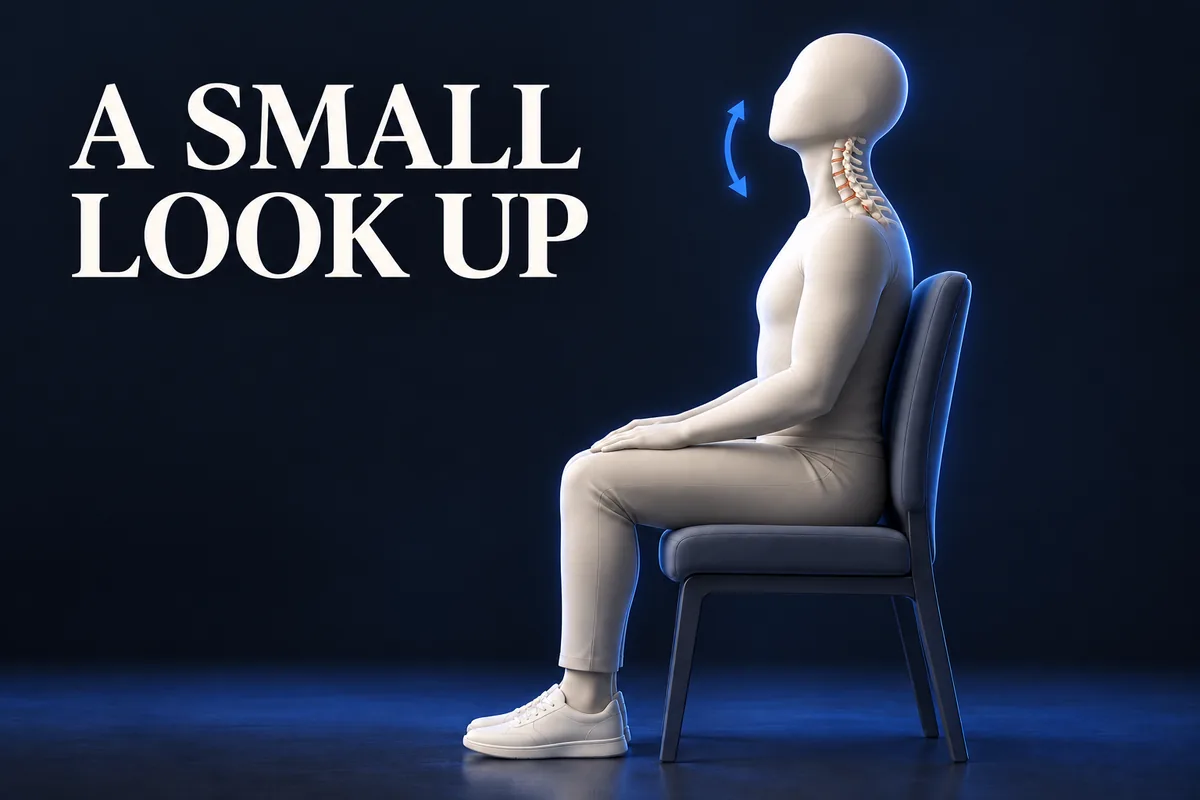
Use a stable chair, support both feet and rest hands on thighs. Keep shoulders relaxed and trunk comfortably upright. Begin looking ahead with the chin gently drawn inward, without forcing a deep tuck. This starting cue appears in the EPUT leaflet, whose clinical schedules are not adopted here.
Make a small upward look
Slowly let the head tip a little upward within comfort. Reaching the ceiling with your gaze is not required. Keep the chest quiet, hands resting and breathing natural. Do not push on the head, lean the whole trunk backward or seek maximum range. Reduce the path or finish if it feels forced.
Return without making a circle
Bring the head slowly back to the comfortable ahead position and pause. You can finish after exploring the path; there is no compulsory count. The backward head glide keeps gaze level, while looking down moves in the opposite direction. Do not combine them into a full neck circle.
Record control and respect symptoms
Note the chair, comfortable path and quiet shoulders, not a target angle. Stop for pain, dizziness, visual changes, tingling, numbness or arm symptoms; North Bristol guidance lists concerning signals. Do not repeat to test them. Vertigo with vision loss, trouble speaking or limb weakness needs emergency help. Fitonomy Mobility is a fitness product; article languages do not establish app language availability.